

Date
- Date
- 22 Nov 2026
Time
- Time
- ...

National Larimar Day
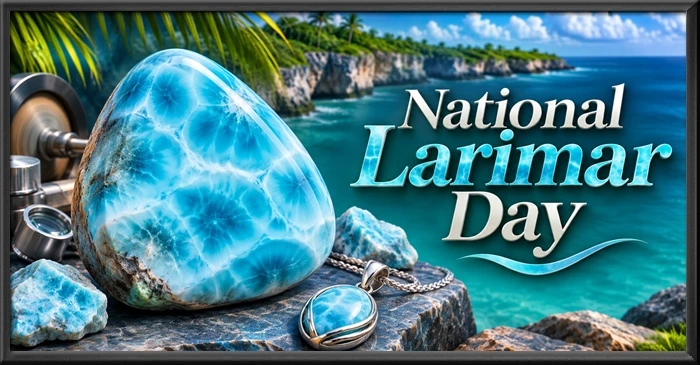
National Larimar Day is observed annually on 22 November.
Established in 2018 under Law No. 17-18 as National Larimar Day, it commemorates priest Miguel Domingo Fuertes's documented identification of larimar in 1916.
The observance celebrates the Dominican Republic's rare blue gemstone and promotes its cultural heritage, sustainable mining, craftsmanship, and international recognition.
National Larimar Day – History, Origin, Objectives and Significance
The distinctive blue gemstone larimar occupies a special place in the natural and cultural heritage of the Dominican Republic. Found in the mountains of Barahona, this rare variety of pectolite is valued for its Caribbean-blue colours, unique patterns, and importance to local jewellery-making traditions.
The country's annual Larimar Day celebration honours the gemstone's historical discovery while recognizing the miners, artisans, and communities whose livelihoods are connected to this natural resource.
History and Origin of International Larimar Day
The history of International Larimar Day dates back to 22 November 1916, when Dominican priest Miguel Domingo Fuertes documented the existence of an unusual blue-green stone near the Bahoruco River in Barahona.
On that date, Fuertes wrote to Archbishop Alejandro Adolfo Nouel, reporting the mineral's existence and seeking permission to explore the deposit.
Although his request did not lead to the immediate development of the gemstone, the correspondence became an important historical record of its early identification.
Decades later, larimar attracted renewed interest and became an important symbol of Dominican geological and cultural heritage.
Rediscovery of Larimar in 1974
In 1974, Dominican artisan Miguel Méndez, assisted by American geologist and Peace Corps volunteer Norman Rilling, helped rediscover larimar in the Barahona region.
The stone was identified as a rare blue variety of the silicate mineral pectolite.
Méndez gave the gemstone its distinctive name by combining Larissa, the name of his daughter, with mar, the Spanish word for sea.
The name reflects the gemstone's blue and turquoise colours, which resemble the waters of the Caribbean Sea.
The rediscovery encouraged the development of gemstone extraction, processing, and jewellery production in the region.
Establishment of Larimar Day in 2018
The Dominican Republic officially established the observance through Law No. 17-18, promulgated on 20 April 2018.
The law declared 22 November of every year as Día Nacional del Larimar, or National Larimar Day.
The date commemorates the historical documentation of the gemstone by Miguel Domingo Fuertes in 1916.
The legislation also assigned government ministries responsibilities for promoting larimar nationally and internationally.
The observance was first celebrated in 2018.
Although International Larimar Day is a widely used alternative name, the official legal designation remains National Larimar Day.
Why Is International Larimar Day Observed on 22 November?
The date was selected to commemorate the correspondence sent by Miguel Domingo Fuertes on 22 November 1916 concerning the blue-green gemstone found in Barahona.
His report provides an important documented milestone in the history of larimar.
The observance connects this historical event with the gemstone's later rediscovery, commercial development, and recognition as a Dominican national symbol.
What Is Larimar?
Larimar is a rare blue gemstone variety of pectolite, a silicate mineral.
It is distinguished by shades ranging from pale blue and turquoise to deeper blue, often accompanied by white patterns or veins.
Gem-quality blue larimar is known from the Dominican Republic, particularly the Sierra de Bahoruco region in Barahona Province.
Its distinctive appearance makes it popular for jewellery, decorative objects, and gemstone collections.
Although ordinary pectolite occurs in other parts of the world, the blue gemstone variety marketed as larimar is associated with the Dominican Republic.
Larimar as the National Stone of the Dominican Republic
On 4 November 2011, the Dominican Republic designated larimar as its national stone through Law No. 296-11.
This recognition acknowledged the gemstone's distinctive origin and importance to the country's natural and cultural identity.
Larimar subsequently gained further recognition through the establishment of National Larimar Day in 2018.
These measures helped strengthen awareness of the stone's geological heritage and economic significance.
Objectives of International Larimar Day
The major objectives of the observance include:
- Preserving the historical and cultural heritage of larimar.
- Promoting the Dominican Republic's unique gemstone internationally.
- Supporting miners, artisans, and jewellery-making communities.
- Encouraging environmentally responsible mining practices.
- Raising awareness about gemstone conservation and sustainable resource management.
- Promoting tourism and local economic development.
- Recognizing the historical contributions of individuals associated with larimar's discovery and rediscovery.
Importance and Significance of International Larimar Day
Larimar plays an important role in the economy and cultural identity of communities in Barahona Province.
The gemstone supports livelihoods connected with mining, cutting, polishing, jewellery manufacturing, and tourism.
Artisans transform raw larimar into necklaces, earrings, rings, pendants, and decorative objects, creating products that represent Dominican craftsmanship.
Its popularity among international visitors also contributes to the country's tourism and handicraft industries.
The observance emphasizes the need to balance economic opportunities with environmental conservation and responsible mining.
How Is International Larimar Day Celebrated?
Larimar Day is marked through educational, cultural, and economic activities, particularly in the Dominican Republic's Barahona region.
Common activities include:
- Gemstone and jewellery exhibitions.
- Traditional craft fairs and artisan demonstrations.
- Educational talks about larimar's geological history.
- Recognition of miners and craftspeople.
- Cultural performances and community gatherings.
- Tourism promotion and gemstone awareness programmes.
- Discussions about sustainable mining and local economic development.
Government institutions and community organizations participate in promoting the gemstone and highlighting its importance to Dominican heritage.
Frequently Asked Questions
When is International Larimar Day observed?
International Larimar Day is observed annually on 22 November.
Which country established Larimar Day?
The Dominican Republic established the observance through Law No. 17-18 in 2018.
What is the official name of International Larimar Day?
Its official name under Dominican law is National Larimar Day (Día Nacional del Larimar).
Who first documented larimar?
Priest Miguel Domingo Fuertes documented the gemstone's existence on 22 November 1916.
Who rediscovered larimar?
Miguel Méndez helped rediscover the gemstone in 1974, working with Norman Rilling.
How did larimar get its name?
Miguel Méndez combined his daughter Larissa's name with the Spanish word mar, meaning sea.
Where is larimar found?
Gem-quality blue larimar is found in the Dominican Republic, primarily in the Barahona region.
When did larimar become the Dominican Republic's national stone?
Larimar was declared the national stone on 4 November 2011 through Law No. 296-11.
Conclusion
International Larimar Day highlights the historical, geological, cultural, and economic importance of one of the Dominican Republic's most distinctive natural resources.
The annual observance honours the gemstone's early documentation, its rediscovery, and the contributions of local mining and artisan communities.
It also promotes the conservation of larimar's heritage and encourages responsible development of the industry associated with this rare Caribbean gemstone.
References
- Dominican Republic Ministry of Energy and Mines – Law No. 17-18 Establishing National Larimar Day
- Dominican Republic Ministry of Energy and Mines – History of Larimar and Its International Recognition
- Gemological Institute of America – Blue Pectolite from the Dominican Republic
- Presidency of the Dominican Republic – Government Initiatives for Larimar Miners and Artisans
- AnydayGuide – International Larimar Day: History and Observance
Also Read : Dominican Republic Independence Day