

Date
- Date
- 10th Nov 1885
Time
- Time
- ...
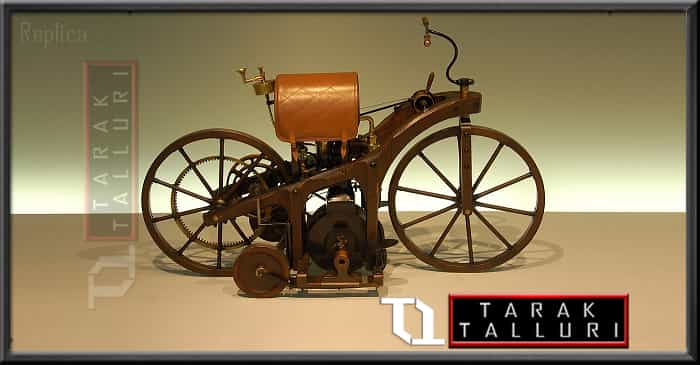
The world's first petrol-powered motorcycle, the Daimler Reitwagen, completed a historic test ride.
On 10 November 1885, the experimental motorcycle developed by Gottlieb Daimler and Wilhelm Maybach travelled between Cannstatt and Untertürkheim in Germany.
Powered by a single-cylinder, four-stroke engine and equipped with stabilizing wheels, it demonstrated the practicality of motorized two-wheeled transport.
Daimler Reitwagen Completed Its Historic Test Ride on 10 November 1885
Introduction
On 10 November 1885, the Daimler Reitwagen, widely recognized as the world's first petrol-powered motorcycle, completed a historic test ride between Cannstatt and Untertürkheim in Germany.
Developed by German engineer Gottlieb Daimler and his collaborator Wilhelm Maybach, the experimental machine demonstrated that a compact internal combustion engine could successfully power a road vehicle.
The successful journey became an important milestone in motorcycle history and helped establish the technical foundations of motorized transportation.
Invention of the Daimler Reitwagen
The Daimler Reitwagen was developed in 1885 in Cannstatt, near Stuttgart, Germany.
Gottlieb Daimler and Wilhelm Maybach were working to produce a lightweight, high-speed internal combustion engine suitable for different forms of transportation.
Their experimental engine became known as the Standuhr, or Grandfather Clock, because of its distinctive upright appearance.
Rather than beginning with a conventional horse-drawn carriage, the engineers constructed a relatively simple, bicycle-like wooden vehicle to test their engine under practical conditions.
The experimental machine was called the Reitwagen, a German term generally translated as riding car or riding carriage.
It consisted of two main wheels, a wooden frame, a leather saddle and a compact engine positioned beneath the rider.
Two smaller outrigger wheels provided additional stability.
Although the vehicle differed considerably from modern motorcycles, its basic arrangement established an important early example of engine-powered personal transportation.
Patent History of the First Motorcycle
Gottlieb Daimler applied for a patent covering the Reitwagen on 29 August 1885.
The German patent, DRP No. 36,423, was issued on 11 August 1886.
The patent represented an important step in the development of road vehicles powered by internal combustion engines.
Daimler had also applied for a patent covering his high-speed, upright-cylinder engine on 3 April 1885.
The combination of these developments enabled Daimler and Maybach to test whether a small combustion engine could operate effectively in a lightweight road vehicle.
The Reitwagen became the practical demonstration of that engineering concept.
Historic Test Ride on 10 November 1885
The most widely commemorated extended test ride of the Daimler Reitwagen took place on 10 November 1885.
The motorcycle travelled between Cannstatt and Untertürkheim, two locations that form part of modern Stuttgart, Germany.
Historical accounts generally describe a journey of approximately three kilometres between the two locations, with the machine also making a return journey.
The route provided an opportunity to evaluate the engine, transmission, stability and handling under real road conditions.
The test demonstrated that a relatively small petrol-powered internal combustion engine could propel a rider over a meaningful distance without assistance from horses or external power.
Who Rode the First Motorcycle?
Historical accounts differ regarding the identity of the rider.
Several historical publications, including accounts from the Hagley Museum and Stuttgart local historians, identify Gottlieb Daimler's son Paul Daimler as the rider.
However, Mercedes-Benz Museum documentation identifies Daimler's son Adolf in its description of the November 1885 journey.
The exact date of the first extended ride is also reported differently in some secondary sources, although 10 November 1885 is supported by Mercedes-Benz and several historical accounts.
These discrepancies concern details of the early test records rather than the Reitwagen's overall importance as a pioneering petrol-powered motorcycle.
Technical Specifications of the Daimler Reitwagen
The Daimler Reitwagen used a compact engine and a simple mechanical arrangement designed primarily for experimentation.
| Specification | Historical Detail |
|---|---|
| Vehicle | Daimler Reitwagen |
| Year | 1885 |
| Developers | Gottlieb Daimler and Wilhelm Maybach |
| Country | Germany |
| Engine | Single-cylinder, four-stroke |
| Displacement | Approximately 264 cc |
| Engine Power | Approximately 0.5 horsepower |
| Engine Speed | Approximately 600 rpm |
| Maximum Speed | Approximately 12 km/h |
| Frame | Wooden construction |
| Wheels | Two main wheels with two outrigger support wheels |
| Transmission | Belt-driven mechanical transmission |
| Historical Classification | Early petrol-powered motorcycle |
The Reitwagen's design combined traditional wooden vehicle construction with emerging internal combustion engine technology.
Its small petrol engine delivered approximately 0.37 kilowatts of power.
Although modest compared with later motorcycle engines, the system was capable of moving the experimental vehicle at speeds approaching 12 kilometres per hour.
Engine and Mechanical Design
The Reitwagen's engine represented one of its most important technical innovations.
Daimler and Maybach developed a lightweight, high-speed four-stroke engine that was considerably more suitable for mobile applications than many earlier stationary engines.
The engine was mounted beneath the leather saddle and used glow-tube ignition.
The ignition system relied on a heated tube rather than the electrical spark ignition systems associated with later motorcycles.
A belt-drive mechanism transferred engine power through the vehicle's mechanical transmission to the rear wheel.
Different drive ratios could be selected while the machine was stationary, but it did not have a modern motorcycle gearbox.
The wooden frame and iron-reinforced wheels reflected the materials and manufacturing methods available during the late nineteenth century.
The additional stabilizing wheels helped keep the experimental vehicle upright, although they also restricted its manoeuvrability.
The machine was therefore primarily an engineering test vehicle rather than a practical production motorcycle.
Was the Daimler Reitwagen Really the World's First Motorcycle?
The Daimler Reitwagen is widely recognized as the first motorcycle powered by a petrol-fuelled internal combustion engine.
However, mechanically propelled two-wheeled vehicles existed before 1885.
Earlier experiments included steam-powered cycles developed during the nineteenth century.
For this reason, the historically precise distinction is that the Daimler Reitwagen was a pioneering petrol-powered motorcycle, not necessarily the first powered two-wheeled machine of every kind.
Its two stabilizing wheels also distinguish it from the conventional two-wheeled motorcycles that subsequently emerged.
Nevertheless, its internal combustion engine, riding position and basic vehicle arrangement contributed to its recognition as a foundational development in motorcycle history.
From the Reitwagen to the Motor Car
The Daimler Reitwagen was not intended to become a mass-produced motorcycle.
Its principal purpose was to demonstrate the practical possibilities of the new high-speed internal combustion engine.
The success of the experimental vehicle encouraged Daimler and Maybach to apply similar technology to other forms of transportation.
In 1886, the engineers adapted their engine technology for a four-wheeled motor carriage.
Their work subsequently contributed to the development of motorboats, rail vehicles and other motorized machines.
The Reitwagen therefore occupied an important place not only in motorcycle history but also in the broader technological development of automobiles and internal combustion transportation.
What Happened to the Original Daimler Reitwagen?
The original Daimler Reitwagen did not survive.
It was destroyed during a major fire at the Daimler works in Cannstatt in June 1903.
However, reconstructed examples were subsequently produced to preserve and demonstrate the historical design.
A replica is displayed at the Mercedes-Benz Museum in Stuttgart, where the Reitwagen forms part of the exhibition dedicated to the pioneers of motorized transportation.
Other museum collections also preserve reconstructed examples of the pioneering vehicle.
These replicas help visitors understand the mechanical principles and construction techniques used in one of the earliest petrol-powered motorcycles.
Historical Significance
The Daimler Reitwagen's historic test ride marked an important step in the development of mechanically powered road transportation.
Its significance can be understood through four major achievements.
First, it demonstrated the practical application of a lightweight petrol-powered internal combustion engine in a road vehicle.
Second, it established an early engineering model for motorized personal transportation.
Third, it contributed to the technical development that eventually led to practical motorcycles and automobiles.
Fourth, it demonstrated the importance of experimental vehicles in testing innovations before their wider commercial application.
The Reitwagen remained an experimental machine, but its successful operation confirmed that compact engines could become an important source of power for future transportation.
Legacy of the World's First Petrol-Powered Motorcycle
The Daimler Reitwagen occupies a notable position in the history of engineering and transportation.
Developed by Gottlieb Daimler and Wilhelm Maybach in 1885, it demonstrated the possibilities of a new generation of lightweight internal combustion engines.
Its historic test ride on 10 November 1885 helped establish the practical feasibility of petrol-powered road vehicles.
Although modern motorcycles differ greatly from the original wooden Reitwagen, the experiment remains one of the foundational milestones in the history of motorized two-wheeled transportation.
References
- Mercedes-Benz Media – Daimler Reitwagen of 1885: On Two Wheels into the Future of Motorized Mobility
https://media.mercedes-benz.com/article/316ff589-6dcb-4fe6-9185-519ec2610bbc - Hagley Museum and Library – November 10, 1885: The First Long-Distance Test Run of the World's First Motorcycle
https://www.hagley.org/research/news/hagley-vault/date-november-10-1885-17-year-old-son-german-inventor-and-engineer - Deutsches Motorrad Museum – Daimler Reitwagen
https://demomu.de/project/daimler-reitwagen/ - Deutschlandmuseum – The Reitwagen, 29 August 1885
https://www.deutschlandmuseum.de/en/history/calendar/1885-08-29-the-reitwagen/ - Untertürkheim Historical Society – Gottlieb Daimler and the Reitwagen
https://www.bv-untertuerkheim.de/gottlieb-daimler.htm - German Patent and Trade Mark Office – Wilhelm Maybach and the First Motorcycle
https://www.dpma.de/dpma/veroeffentlichungen/meilensteine/dasautoundseineanfaenge/maybach/index.html
Also Read : The first mobile phone call in India was made