

Date
- Date
- 27 Nov 2027
Time
- Time
- ...

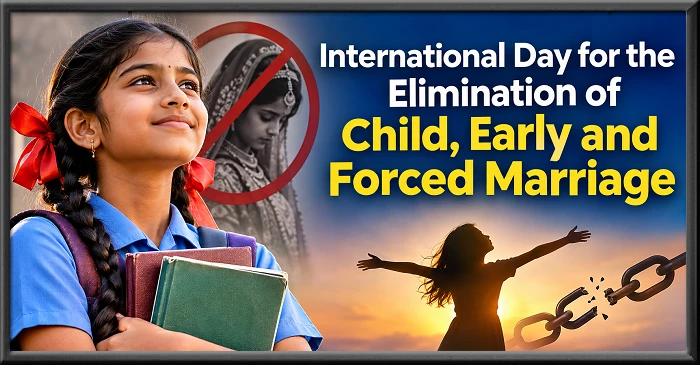
International Day for the Elimination of Child, Early and Forced Marriage
International Day for the Elimination of Child, Early and Forced Marriage is observed annually on 27 November.
It is to raise awareness about the harmful practice of child, early and forced marriage, protect children's rights, promote gender equality and ensure freedom of choice in marriage.
Established by the United Nations General Assembly on 4 September 2026 through Resolution A/RES/80/309 and was first observed on 27 November 2026.
History and Origin
On 4 September 2026, the United Nations General Assembly adopted Resolution A/RES/80/309 by consensus, officially proclaiming 27 November as the International Day for the Elimination of Child, Early and Forced Marriage.
The resolution was led by Sierra Leone, with support from India and other countries.
The international campaign for establishing the day was initiated by Bhuwan Ribhu, founder of Just Rights for Children, at the United Nations Commission on the Status of Women in March 2026. It was subsequently championed by Fatima Maada Bio, First Lady of Sierra Leone and President of the Organization of African First Ladies for Development (OAFLAD).
The first official observance took place on 27 November 2026.
Why 27 November?
The date holds particular historical significance for India.
On 27 November 2024, the Government of India launched the Bal Vivah Mukt Bharat (Child Marriage Free India) campaign to eliminate child marriage through government intervention, public participation, legal enforcement and community awareness.
The Indian campaign helped inspire the international movement for establishing a dedicated global observance against child marriage.
Understanding Child, Early and Forced Marriage
Child marriage refers to a formal marriage or an informal marital union involving at least one individual below the age of 18.
Early marriage generally refers to marriage before an individual has attained sufficient physical, emotional or psychological maturity.
Forced marriage occurs when one or both individuals enter a marriage without their voluntary, informed and unrestricted consent.
Although these practices can affect both boys and girls, girls are disproportionately affected because of existing gender inequalities and discriminatory social norms.
Causes of Child, Early and Forced Marriage
Several interconnected factors contribute to the continuation of these harmful practices:
- Poverty and economic insecurity.
- Gender inequality and discrimination.
- Limited access to education.
- Harmful traditional and social practices.
- Family and community pressure.
- Weak enforcement of child protection laws.
- Humanitarian crises, conflict and displacement.
Addressing these underlying causes is essential to achieving lasting social change.
Global Impact of Child Marriage
According to UNICEF estimates, approximately 650 million girls and women living worldwide were married before reaching the age of 18. Around 12 million girls continue to enter marriage during childhood every year.
Child marriage can interrupt education, restrict employment opportunities, increase the risks associated with adolescent pregnancy and expose individuals to domestic violence, social isolation and economic dependency.
It also contributes to intergenerational poverty and inequality, affecting families, communities and national development.
Objectives of theInternational Day for the Elimination of Child Early and Forced Marriage
- Eliminate child, early and forced marriage worldwide.
- Protect children's fundamental rights and freedoms.
- Promote gender equality and the empowerment of girls.
- Ensure free and informed consent in marriage.
- Strengthen legislation and child protection mechanisms.
- Expand educational and economic opportunities.
- Support survivors and individuals at risk.
- Encourage international cooperation and community participation.
Connection with the Sustainable Development Goals
The observance supports the United Nations 2030 Agenda for Sustainable Development, particularly Sustainable Development Goal 5, which focuses on gender equality and the empowerment of women and girls.
SDG Target 5.3 specifically calls for the elimination of harmful practices, including child, early and forced marriage and female genital mutilation.
The international day reinforces the responsibility of governments, institutions and communities to accelerate progress towards achieving this target by 2030.
How theInternational Day for the Elimination of Child Early and Forced Marriage Is Observed
The day provides opportunities for governments, United Nations agencies, educational institutions, civil society organisations and communities to organise:
- Public awareness campaigns.
- Educational programmes and workshops.
- Community pledges against child marriage.
- Policy discussions and advocacy initiatives.
- Survivor support and empowerment programmes.
- Child rights awareness activities.
- International cooperation and fundraising initiatives.
Significance
The International Day for the Elimination of Child, Early and Forced Marriage represents an important international commitment to protecting childhood, safeguarding human dignity and ensuring equality.
Its ultimate purpose is to create a world where every child can grow up safely, pursue an education and determine their future without coercion, discrimination or premature marriage.
Ending child, early and forced marriage is not merely a social responsibility but a fundamental human rights obligation.
References
- United Nations – International Day for the Elimination of Child, Early and Forced Marriage
- United Nations General Assembly – Resolution A/RES/80/309
- UNICEF – Child Marriage: Global Data and Statistics
- Child Marriage Free World – History and Establishment of the International Day
- Government of India – Launch of Bal Vivah Mukt Bharat Campaign
- United Nations – Sustainable Development Goal 5: Gender Equality
Also Read : World Cervical Cancer Elimination Day