
Date
- Date
- 24 Oct 2027
Time
- Time
- ...

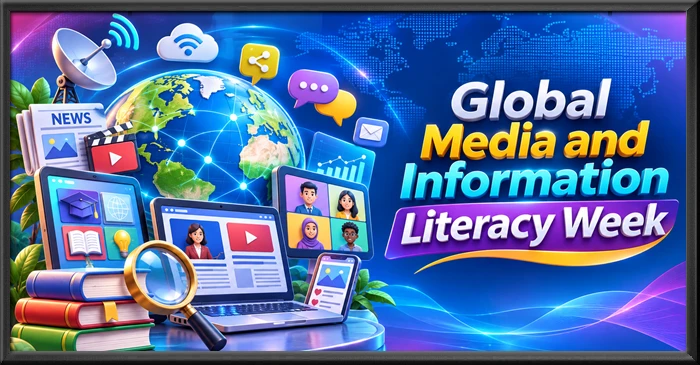
Global Media and Information Literacy Week
Global Media and Information Literacy Week is observed annually from 24 to 31 October.
Proposed in the 2011 Fez Declaration in Morocco, the UNESCO-led observance began in 2012 and received United Nations recognition in 2021.
It promotes critical thinking, responsible media use, fact-checking, and digital literacy to help people identify misinformation and access reliable information.
History and Origin of Global Media and Information Literacy Week
The history of Global Media and Information Literacy Week, commonly known as Global MIL Week, is closely connected to international efforts to strengthen media education, information literacy, critical thinking, and responsible communication.
The initiative emerged from cooperation among educators, researchers, media professionals, international organisations, and policymakers who recognised the growing importance of helping people evaluate information in an increasingly connected world.
Early Foundations of Media & Information Literacy
International efforts to promote media education existed long before Global MIL Week was established.
In 1982, UNESCO supported the adoption of the Grünwald Declaration on Media Education in Grünwald, Germany.
The declaration emphasised the importance of developing citizens' critical understanding of mass media and encouraging media education.
Subsequent international initiatives expanded the discussion to include information literacy, digital communication, and access to knowledge.
The Prague Declaration of 2003 and the Alexandria Proclamation of 2005 helped strengthen international recognition of information literacy as an essential component of education and lifelong learning.
These developments laid the intellectual and institutional foundations for the later Global Media and Information Literacy Week.
Fez Declaration — 2011
The immediate origins of Global Media and Information Literacy Week can be traced to the First International Forum on Media & Information Literacy, held from 15 to 17 June 2011 in Fez, Morocco.
The forum brought together experts, educators, researchers, and representatives of international organisations.
UNESCO participated as a leading partner, alongside the United Nations Alliance of Civilizations (UNAOC) and other organisations.
On 17 June 2011, participants adopted the Fez Declaration on Media & Information Literacy.
The declaration called for international cooperation in promoting media and information literacy and proposed establishing a dedicated global awareness week.
Its original proposal suggested 15–21 June as a possible annual observance period.
The eventual internationally recognised dates, however, became 24–31 October.
The Fez Declaration represents a foundational historical milestone in the development of Global MIL Week.
Beginning of Annual Global MIL Week — 2012
The UNESCO-led annual Global Media and Information Literacy Week initiative began in 2012, building on the proposals and international cooperation established in Fez.
The initiative created a platform for educators, media professionals, information specialists, researchers, students, and civil society organisations to exchange knowledge and promote media and information literacy.
International conferences, educational activities, research discussions, and collaborative programmes contributed to its development.
The campaign gradually expanded into a global observance involving organisations and participants from different countries.
UNESCO Recognition — 2019
An important milestone occurred on 25 November 2019, when the 40th session of the UNESCO General Conference adopted Resolution 56 concerning Global Media and Information Literacy Week.
The resolution formally proclaimed 24–31 October as the annual observance period.
It encouraged UNESCO Member States, educational institutions, international organisations, civil society groups, and other stakeholders to promote media and information literacy through educational and public awareness activities.
This decision strengthened the institutional recognition of Global MIL Week.
United Nations Recognition — 2021
On 25 March 2021, the United Nations General Assembly adopted Resolution A/RES/75/267, formally proclaiming 24–31 October of every year as Global Media and Information Literacy Week.
The resolution recognised the importance of access to reliable, timely, understandable, and scientifically grounded information.
It also acknowledged that differences in digital access and information skills can contribute to inequalities between and within countries.
The United Nations encouraged governments, international organisations, educational institutions, and civil society to participate in commemorative and educational activities.
This recognition established Global MIL Week as an official United Nations international observance.
When Is Global Media and Information Literacy Week Observed?
Global Media & Information Literacy Week is observed annually from 24 October to 31 October.
These dates are fixed and do not depend on weekdays or the position of a particular week within October.
The observance covers eight calendar dates, including both the starting and ending days.
UNESCO and its partners may organise major conferences or regional events on selected dates within or around the observance period.
What Is Media and Information Literacy?
Media and Information Literacy (MIL) refers to the knowledge, skills, attitudes, and abilities that enable people to access, understand, critically evaluate, create, and share information responsibly.
It brings together two closely related areas.
Media literacy involves understanding how media organisations, digital platforms, and communication systems produce and distribute content.
Information literacy focuses on identifying information needs, locating relevant sources, evaluating their reliability, and using information effectively.
Together, these competencies help individuals navigate newspapers, television, websites, social media, search engines, digital libraries, and emerging technologies.
Media and information literacy also supports informed decision-making, freedom of expression, participation in public life, and responsible digital citizenship.
Objectives and Significance
The principal objective of Global Media & Information Literacy Week is to encourage societies to develop the skills required to understand and evaluate information.
Its major objectives include:
- Promoting critical thinking and information evaluation.
- Strengthening media education and digital literacy.
- Encouraging responsible production and sharing of information.
- Raising awareness of misinformation and disinformation.
- Supporting access to reliable and credible information sources.
- Promoting ethical communication and digital citizenship.
- Encouraging freedom of expression and access to information.
- Improving understanding of digital rights and responsibilities.
- Strengthening international cooperation in media and information literacy.
The observance highlights the importance of these skills in education, journalism, public communication, and democratic participation.
Global MIL Week and the Fight Against Misinformation
The rapid expansion of digital platforms has transformed how information is produced, distributed, and consumed.
Social media enables information to reach large audiences quickly, but false or misleading material can spread through the same channels.
Media and information literacy helps individuals assess the reliability of sources, compare evidence, identify misleading claims, and recognise potentially manipulated content.
It encourages people to examine information before accepting or sharing it.
These abilities are particularly important during public emergencies, elections, health crises, and other situations in which inaccurate information can affect public decisions.
Global MIL Week provides opportunities to promote fact-checking, source verification, responsible journalism, and evidence-based communication.
The Importance of Media Literacy in the Age of Artificial Intelligence
Artificial intelligence has introduced new opportunities and challenges in digital communication.
AI technologies can assist with education, translation, research, content creation, and information discovery.
However, AI-generated images, synthetic videos, fabricated audio, and misleading automated content can make it more difficult to distinguish authentic material from manipulated information.
Media and information literacy encourages users to examine the origin of digital content, assess supporting evidence, understand potential biases, and recognise the limitations of automated systems.
These skills also help people use AI tools responsibly while protecting personal information and respecting digital rights.
As emerging technologies continue to develop, media and information literacy remains important for informed and responsible participation in digital society.
The Role of UNESCO in Global MIL Week
UNESCO plays a leading role in promoting Global Media and Information Literacy Week.
The organisation works with governments, educational institutions, researchers, media professionals, civil society organisations, and international partners.
Its activities include developing educational resources, encouraging policy cooperation, supporting professional training, and facilitating international discussions.
UNESCO also coordinates global conferences and supports regional activities that highlight developments in media and information literacy.
The UNESCO Media and Information Literacy Alliance provides a platform for collaboration among organisations and individuals committed to advancing these skills worldwide.
How Is Global Media & Information Literacy Week Observed?
Global MIL Week is marked through educational, professional, and community activities organised across different countries.
International Conferences
UNESCO and its partners organise conferences bringing together policymakers, educators, researchers, journalists, and information specialists.
These events explore developments in media education, information access, digital communication, and public policy.
Educational Workshops
Schools, colleges, universities, and community organisations conduct programmes explaining how to evaluate media content and identify reliable information.
Fact-Checking Programmes
Journalists, educators, and media literacy organisations promote techniques for verifying information and identifying misleading claims.
Digital Literacy Campaigns
Awareness activities encourage responsible technology use, online safety, privacy awareness, and digital citizenship.
Youth Participation
Young people participate in discussions, workshops, competitions, and collaborative initiatives addressing contemporary information challenges.
Community Awareness Activities
Public libraries, educational institutions, and civil society organisations may conduct seminars, exhibitions, and information-literacy sessions.
These activities help extend the observance beyond professional discussions to wider public participation.
Historical Milestones
Several important developments contributed to the establishment and international recognition of Global Media & Information Literacy Week.
- 1982: The Grünwald Declaration on Media Education helped advance international recognition of media education.
- 2003: The Prague Declaration emphasised the importance of information literacy.
- 2005: The Alexandria Proclamation strengthened the relationship between information literacy and lifelong learning.
- 2011: The Fez Declaration proposed an international awareness week dedicated to media and information literacy.
- 2012: The UNESCO-led annual Global MIL Week initiative began.
- 2013: The Global Alliance for Partnerships on Media and Information Literacy framework strengthened international cooperation.
- 2019: UNESCO formally proclaimed Global Media & Information Literacy Week for 24–31 October.
- 2021: The United Nations General Assembly proclaimed the observance through Resolution A/RES/75/267.
These milestones demonstrate how international cooperation helped transform media and information literacy from an educational priority into a globally recognised public awareness initiative.
Frequently Asked Questions
When is Global Media & Information Literacy Week observed?
It is observed annually from 24 to 31 October.
When did Global Media & Information Literacy Week begin?
The initiative originated in the 2011 Fez Declaration in Morocco, and the UNESCO-led annual observance began in 2012.
Who initiated Global Media & Information Literacy Week?
The idea emerged from participants at the 2011 international media and information literacy forum in Fez, Morocco. UNESCO subsequently played the leading international role in developing and coordinating the observance.
When did UNESCO officially recognise Global MIL Week?
The UNESCO General Conference formally proclaimed the observance on 25 November 2019.
When did the United Nations recognise Global MIL Week?
The United Nations General Assembly adopted Resolution A/RES/75/267 on 25 March 2021.
What does MIL stand for?
MIL stands for Media and Information Literacy.
What is the purpose of Global MIL Week?
Its purpose is to promote critical thinking, information literacy, responsible media use, digital citizenship, and access to reliable information.
Is Global Media & Information Literacy Week a United Nations observance?
Yes. The United Nations General Assembly formally proclaimed the annual observance in 2021.
Is Global MIL Week celebrated worldwide?
Yes. UNESCO, international organisations, educational institutions, media professionals, and community groups participate in activities across different countries.
Conclusion
Global Media and Information Literacy Week reflects the increasing importance of reliable information, critical thinking, and responsible communication in modern society.
Originating from the 2011 Fez Declaration and developing into an annual international initiative, it received formal recognition from UNESCO in 2019 and the United Nations in 2021.
Its historical development demonstrates a growing international commitment to strengthening information literacy, addressing misinformation, and empowering people to participate responsibly in an evolving digital world.
References
- UNESCO — Global Media & Information Literacy Week (Official Observance)
https://www.unesco.org/en/weeks/media-information-literacy - United Nations — Global Media & Information Literacy Week
https://www.un.org/en/observances/media-information-literacy-week - UNESCO — Global MIL Week: Media and Information Literacy for the Public Good (2021)
https://www.unesco.org/en/articles/media-and-information-literacy-public-good-global-mil-week-2021 - UNESCO IITE — Global Media & Information Literacy Week 2021: Historical Background
https://iite.unesco.org/announcements/global-mil-week-2021/ - United Nations Alliance of Civilizations — Fez Declaration on Media and Information Literacy (17 June 2011)
https://www.unaoc.org/wp-content/uploads/FEZ_DECLARATION-ON-MEDIA-AND-INFORMATION-LITERACY-JUNE-17-2011.pdf - UNESCO — General Conference Resolution 56 (2019)
https://www.unesco.org/sites/default/files/medias/files/2022/02/global_mil_week_unesco_gc_resolution.pdf - United Nations — General Assembly Resolution A/RES/75/267 (2021)
https://documents.un.org/doc/undoc/gen/n21/076/41/pdf/n2107641.pdf - UNESCO — Media and Information Literacy
https://www.unesco.org/en/media-information-literacy
Also Read: World Social Media Day