

Date
- Date
- 15 Nov 2026
Time
- Time
- ...

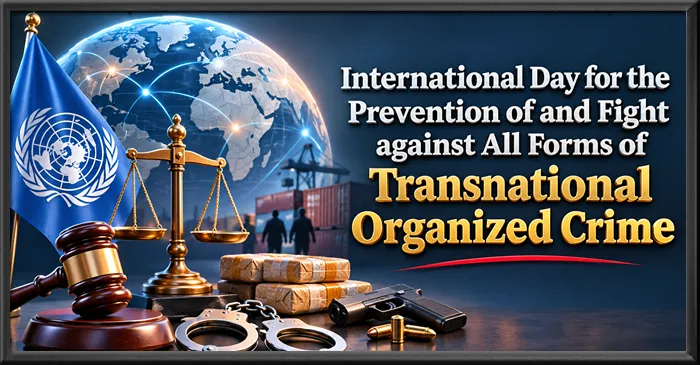
International Day for the Prevention of and Fight against All Forms of Transnational Organized Crime
International Day for the Prevention of and Fight against All Forms of Transnational Organized Crime is observed annually on 15 November.
Established by the United Nations General Assembly on 21 March 2024 through Resolution 78/267 and first observed in 2024.
The day promotes awareness, international cooperation, crime prevention, and protection against transnational organized criminal activities.
International Day for the Prevention of and Fight against All Forms of Transnational Organized Crime
The International Day for the Prevention of and Fight against All Forms of Transnational Organized Crime is observed annually on 15 November to raise awareness about transnational organized crime and promote international cooperation in preventing and combating criminal activities across national borders.
Established by the United Nations General Assembly on 21 March 2024 through Resolution 78/267, the observance was first commemorated on 15 November 2024.
The day highlights the importance of international law, crime prevention, law enforcement cooperation, human rights, and sustainable development in addressing organized criminal networks.
History and Origin of the International Day against Transnational Organized Crime
The history of the International Day for the Prevention of and Fight against All Forms of Transnational Organized Crime is closely linked to international efforts to combat organized criminal networks.
Transnational organized crime includes criminal activities involving networks operating across national borders or producing significant consequences in more than one country.
These activities can threaten public safety, economic stability, human rights, governance, and the rule of law.
Recognising these threats, the United Nations developed international legal frameworks to strengthen cooperation between countries.
A major milestone occurred on 15 November 2000, when the United Nations General Assembly adopted the United Nations Convention against Transnational Organized Crime through Resolution 55/25.
More than two decades later, the General Assembly established a dedicated international observance to strengthen awareness and cooperation against organized crime.
On 21 March 2024, it adopted Resolution 78/267, declaring 15 November the annual International Day for the Prevention of and Fight against All Forms of Transnational Organized Crime.
When Was the International Day First Observed?
The first International Day for the Prevention of and Fight against All Forms of Transnational Organized Crime was observed on 15 November 2024.
The United Nations Office on Drugs and Crime (UNODC) coordinated awareness activities and supported international participation.
A high-level commemorative event was held in Vienna, Austria, on 15 November 2024.
The event brought attention to the devastating effects of organized crime on individuals, communities, institutions, and economies.
It also emphasised the importance of international collaboration, stronger justice systems, and coordinated action against criminal organisations.
Why Is the International Day Observed on November 15?
The International Day is observed on 15 November because the date commemorates the adoption of the United Nations Convention against Transnational Organized Crime on 15 November 2000.
The treaty, commonly known as the Palermo Convention, established an international legal framework for cooperation against transnational organized criminal activities.
The Convention was opened for signature at a high-level conference in Palermo, Italy, from 12 to 15 December 2000.
It subsequently entered into force on 29 September 2003.
The selection of 15 November connects the annual observance with this important milestone in the history of international criminal justice.
Who Established the International Day?
The International Day for the Prevention of and Fight against All Forms of Transnational Organized Crime was officially established by the United Nations General Assembly.
On 21 March 2024, the General Assembly adopted Resolution 78/267 without a vote.
The resolution called for greater public awareness of the threats posed by organized crime and stronger international cooperation in addressing these threats.
It invited Member States, international organisations, civil society, academic institutions, private-sector organisations, and the media to participate in commemorative activities.
The resolution also invited the United Nations Office on Drugs and Crime to facilitate the annual observance in collaboration with relevant partners.
What Is Transnational Organized Crime?
Transnational organized crime refers to serious criminal activities involving organised groups whose activities or consequences extend across national borders.
Such criminal networks often operate through multiple countries and exploit differences in legal systems, law enforcement capacities, and economic conditions.
Major forms of transnational organized crime include:
- Human trafficking and exploitation.
- Smuggling of migrants.
- Illicit drug trafficking.
- Illegal firearms trafficking.
- Money laundering and financial crime.
- Illegal wildlife and natural resource trafficking.
- Trafficking in cultural property.
- Organized cyber-enabled fraud and financial scams.
- Trafficking in falsified medical products.
- Corruption and obstruction of justice associated with criminal organisations.
These activities can undermine governance, threaten human rights, and destabilise communities.
United Nations Convention against Transnational Organized Crime
The United Nations Convention against Transnational Organized Crime (UNTOC) is the principal international treaty addressing transnational organized criminal activity.
Adopted on 15 November 2000, the Convention provides a framework for cooperation between countries in investigating, prosecuting, and preventing organized crime.
Its principal areas of cooperation include:
- Mutual legal assistance between countries.
- Extradition procedures.
- International law enforcement cooperation.
- Measures against money laundering.
- Prevention of corruption.
- Protection of witnesses and victims.
- Technical assistance and capacity-building.
The Convention is supplemented by three important protocols.
1. Trafficking in Persons Protocol
The Protocol to Prevent, Suppress and Punish Trafficking in Persons, Especially Women and Children, addresses human trafficking and promotes the protection of victims.
2. Smuggling of Migrants Protocol
The Protocol against the Smuggling of Migrants by Land, Sea and Air addresses organized migrant smuggling and promotes international cooperation while recognising the need to protect migrants' rights.
3. Firearms Protocol
The Protocol against the Illicit Manufacturing of and Trafficking in Firearms, Their Parts and Components and Ammunition addresses illegal firearms manufacturing and trafficking.
Together, the Convention and its protocols provide a major international legal framework for combating organized crime.
Objectives of the International Day
The principal objectives of the International Day for the Prevention of and Fight against All Forms of Transnational Organized Crime include:
- Raising public awareness about the threats posed by transnational organized crime.
- Strengthening cooperation between countries and international organisations.
- Encouraging effective crime prevention strategies.
- Promoting the implementation of international legal agreements.
- Supporting the protection of victims and vulnerable communities.
- Improving cooperation between law enforcement and judicial authorities.
- Addressing illicit financial flows and money laundering.
- Encouraging educational programmes and public participation.
- Supporting sustainable development, justice, and the rule of law.
- Honouring victims and individuals who have sacrificed their lives in combating organized crime.
These objectives reflect the importance of coordinated international action against criminal networks.
Role of the United Nations Office on Drugs and Crime
The United Nations Office on Drugs and Crime (UNODC) plays an important role in international efforts to prevent and combat transnational organized crime.
UNODC assists governments in strengthening criminal justice systems, improving international cooperation, and implementing relevant conventions.
Its activities include research, technical assistance, training, legislative support, and capacity-building.
The organisation also promotes international cooperation in addressing human trafficking, migrant smuggling, corruption, illicit trafficking, money laundering, and other forms of organized crime.
Under Resolution 78/267, UNODC was invited to facilitate the annual International Day in cooperation with relevant organisations and stakeholders.
Giovanni Falcone and the Fight against Organized Crime
The International Day also recognises individuals whose work contributed to international efforts against organized crime.
Among them is Giovanni Falcone, an Italian magistrate internationally recognised for his efforts against the Sicilian Mafia.
Falcone played a major role in investigating and prosecuting organized criminal networks in Italy.
He was assassinated in a Mafia bombing near Palermo on 23 May 1992.
His work and sacrifice became enduring symbols of the struggle against organized crime.
United Nations General Assembly Resolution 78/267 specifically pays tribute to individuals such as Falcone, whose contributions helped lay the foundations for international cooperation against organized crime.
The observance also commemorates victims of organized crime and law enforcement and judicial personnel who have lost their lives confronting criminal organisations.
How Is the International Day Observed?
The International Day for the Prevention of and Fight against All Forms of Transnational Organized Crime is commemorated through educational, institutional, and public awareness activities.
Common observances include:
- International conferences and policy discussions.
- Public awareness campaigns on organized crime.
- Educational seminars about criminal justice and human rights.
- Law enforcement cooperation programmes.
- Discussions on trafficking, money laundering, and cybercrime.
- Community programmes supporting victims.
- Research publications and expert discussions.
- Initiatives promoting international legal cooperation.
Governments, international organisations, civil society groups, educational institutions, and private-sector organisations are encouraged to participate.
Significance of the International Day
The International Day highlights the global consequences of organized crime and the importance of collective action.
Criminal networks can operate across borders, exploit vulnerable communities, and undermine public institutions.
Their activities can contribute to violence, corruption, economic losses, environmental destruction, and human rights violations.
The observance emphasises that international cooperation is essential because individual countries cannot effectively address all aspects of transnational organized crime in isolation.
It also reinforces the relationship between effective crime prevention, accountable institutions, human rights, and sustainable development.
Historical Significance and Legacy
The International Day for the Prevention of and Fight against All Forms of Transnational Organized Crime represents a significant development in the United Nations' efforts to strengthen global cooperation against organized criminal networks.
Its establishment on 21 March 2024 and first observance on 15 November 2024 connect the modern campaign against organized crime with the adoption of the Palermo Convention on 15 November 2000.
The observance also honours the contributions and sacrifices of individuals who have worked to protect society from organized criminal activities.
Observed annually on 15 November, the International Day continues to promote crime prevention, international cooperation, justice, public awareness, and the protection of vulnerable communities worldwide.
References
- United Nations – International Day for the Prevention of and Fight against All Forms of Transnational Organized Crime
https://www.un.org/en/observances/fight-against-transnational-crime-day - United Nations General Assembly – Resolution 78/267, Adopted on 21 March 2024
https://digitallibrary.un.org/record/4043248 - United Nations Audiovisual Library of International Law – United Nations Convention against Transnational Organized Crime and Its Protocols
https://legal.un.org/avl/ha/unctoc/unctoc.html - United Nations Web TV / UNODC – First International Day High-Level Commemoration, 15 November 2024
https://webtv.un.org/en/asset/k1d/k1do697at4 - Permanent Mission of Italy to the United Nations – Historical Significance of November 15 and the Palermo Convention
https://italyun.esteri.it/en/news/dalla_rappresentanza/2024/11/press-release-exhibit-to-pay-tribute-to-judges-falcone-and-borsellino-on-the-occasion-of-the-international-day-on-the-fight-against-transnational-organized-crime/
Also Read : India Enacted the SC/ST (Prevention of Atrocities) Act