

Date
- Date
- 3 Nov 2026
Time
- Time
- ...

World Jellyfish Day
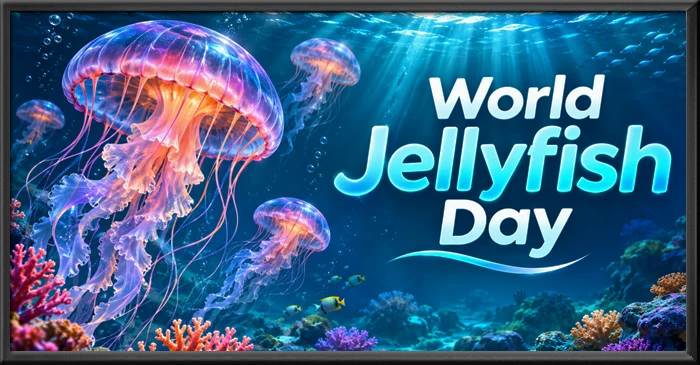
World Jellyfish Day is observed annually on November 3.
The observance celebrates jellyfish, their extraordinary evolutionary history, and their important role in marine ecosystems.
It promotes awareness of jellyfish biology, ocean biodiversity, and marine conservation.
These ancient invertebrates inhabit oceans worldwide and provide valuable insights into the health and complexity of marine environments.
World Jellyfish Day: History, Significance and Fascinating Facts
World Jellyfish Day is celebrated every year on November 3 to recognise one of the oldest and most fascinating groups of marine animals on Earth. The observance highlights the remarkable biology, evolutionary survival, ecological importance, and diversity of jellyfish while encouraging greater public understanding of ocean ecosystems.
Despite their delicate, transparent appearance, jellyfish are highly successful marine predators that have survived for hundreds of millions of years. Their unusual anatomy, complex life cycles, and ability to thrive in diverse marine environments make them important subjects of scientific research.
History and Origin of World Jellyfish Day
World Jellyfish Day is observed annually on November 3, with observance calendars tracing its celebration to 2014. However, the identity of its original founder and the precise circumstances surrounding its establishment have not been conclusively documented in authoritative historical sources.
The observance became increasingly visible through marine research institutions, aquariums, conservation organisations, and educational initiatives.
On November 3, 2018, researchers associated with the University of Bergen in Norway published an article recognising World Jellyfish Day and discussing international jellyfish research.
The following year, on November 3, 2019, the United States National Oceanic and Atmospheric Administration (NOAA) marked the occasion by publishing educational information about jellyfish and their marine habitats.
Today, the observance provides an opportunity to appreciate jellyfish as essential components of marine biodiversity rather than viewing them merely as dangerous or troublesome sea creatures.
What Are Jellyfish?
Jellyfish are gelatinous marine invertebrates belonging to the phylum Cnidaria, which also includes corals and sea anemones.
Although commonly called jellyfish, these animals are not true fish. They lack backbones and possess a distinctive body structure adapted to life in aquatic environments.
Their bodies typically consist of a bell-shaped structure and specialised feeding structures, with many species possessing trailing tentacles.
Approximately 95% of a jellyfish's body consists of water, giving it a translucent and flexible appearance.
Unlike vertebrate animals, jellyfish do not possess a conventional brain, heart, bones, or blood. Instead, they rely on nerve networks and specialised sensory structures to detect environmental changes and coordinate movement.
Jellyfish inhabit marine environments ranging from coastal waters to the deep ocean.
Evolutionary History of Jellyfish
Jellyfish belong to one of the most ancient evolutionary lineages of animals.
Fossil evidence demonstrates that jellyfish-like animals existed more than 500 million years ago, during the Cambrian Period.
In 2023, scientists formally described Burgessomedusa phasmiformis, an approximately 505-million-year-old jellyfish discovered in Canada's Burgess Shale fossil deposits.
The discovery provided important evidence about the early evolution of free-swimming jellyfish.
Because jellyfish have soft bodies without bones or shells, their fossils are exceptionally rare. Their preservation requires unusual geological conditions.
Their long evolutionary history demonstrates the effectiveness of a comparatively simple body structure in surviving major environmental changes over geological time.
Why Is World Jellyfish Day Important?
World Jellyfish Day promotes scientific understanding, marine conservation, and public appreciation of organisms that are frequently misunderstood.
1. Marine biodiversity awareness
Jellyfish form an important part of marine biodiversity and contribute to the functioning of ocean ecosystems.
2. Understanding marine food webs
Jellyfish consume plankton, fish larvae, small crustaceans, and other marine organisms. They are also eaten by sea turtles, fish, and several other ocean predators.
3. Marine scientific research
Studying jellyfish helps researchers understand marine food webs, animal evolution, reproductive biology, and the environmental factors affecting marine populations.
4. Ocean conservation
The observance provides an opportunity to educate communities about plastic pollution, habitat degradation, sustainable fisheries, and the importance of protecting marine environments.
5. Public safety and education
Understanding jellyfish behaviour and identifying potentially dangerous species helps coastal communities and beach visitors reduce risks associated with jellyfish encounters.
The Life Cycle of Jellyfish
Many true jellyfish undergo a fascinating life cycle involving several developmental stages.
- Planula: A fertilised egg develops into a small, free-swimming larva.
- Polyp: The larva attaches to a surface and develops into a stationary polyp.
- Strobila: In certain species, the polyp undergoes a process called strobilation, producing young jellyfish.
- Ephyra: A juvenile jellyfish separates from the polyp and begins swimming independently.
- Medusa: The jellyfish develops into its recognisable adult, bell-shaped form.
The exact life cycle differs among jellyfish groups, and not all species undergo every stage in the same way.
Fascinating Facts About Jellyfish
1. Jellyfish existed before dinosaurs. Their evolutionary history extends back more than 500 million years.
2. Jellyfish are not fish. They are invertebrates belonging to the phylum Cnidaria.
3. Their bodies are approximately 95% water. This explains their gelatinous and translucent appearance.
4. Jellyfish do not have a conventional brain or heart. Their nervous systems allow them to respond to environmental stimuli.
5. Jellyfish use specialised stinging cells. Structures called nematocysts help many species capture prey and defend themselves.
6. Some jellyfish produce light. Certain species exhibit bioluminescence, generating light through biological processes.
7. Jellyfish can form large aggregations. Groups of jellyfish are commonly described as blooms or swarms.
8. Not all jellyfish stings are dangerous to humans. Sting severity differs considerably among species, although some box jellyfish can cause life-threatening injuries.
9. Jellyfish are an important food source. Leatherback sea turtles and several fish species regularly consume jellyfish.
10. Jellyfish have travelled into space. Nearly 2,500 moon jellyfish polyps and juvenile stages were carried aboard Space Shuttle Columbia in 1991 to study development in microgravity.
Major Types of Jellyfish
Several groups and species of jellyfish are particularly well known.
Moon Jellyfish (Aurelia species)
Recognised by their translucent, circular bells, moon jellyfish are widely studied for their developmental biology and reproductive cycles.
Box Jellyfish (Class Cubozoa)
These jellyfish possess distinctive cube-shaped bells. Certain species have extremely potent venom and pose serious risks to swimmers.
Lion's Mane Jellyfish (Cyanea capillata)
Known for its large bell and long trailing tentacles, the lion's mane jellyfish is among the largest known jellyfish species.
Upside-Down Jellyfish (Cassiopea species)
These jellyfish often rest with their bells facing downward and their oral arms directed toward sunlight. Many maintain symbiotic relationships with photosynthetic algae.
Jellyfish and Marine Ecosystems
Jellyfish play complex ecological roles as both predators and prey.
They consume various planktonic organisms and can influence the abundance and composition of marine plankton communities.
At the same time, jellyfish support numerous predators, including leatherback sea turtles, ocean sunfish, and other marine animals.
When jellyfish die and sink, their organic matter can also contribute to the transfer of nutrients and carbon into deeper marine environments.
Large jellyfish aggregations, commonly called jellyfish blooms, sometimes interfere with fishing activities, coastal tourism, and industrial water-intake systems.
Researchers have investigated how factors such as changing ocean temperatures, nutrient pollution, fishing pressure, and coastal development can influence jellyfish populations. Their responses differ among species and regions, and not all jellyfish populations are increasing globally.
Jellyfish and Ocean Conservation
World Jellyfish Day encourages broader awareness of the environmental challenges affecting marine ecosystems.
Plastic pollution is particularly concerning because floating plastic materials can resemble gelatinous prey. Marine animals, including sea turtles, may accidentally consume plastic waste.
Habitat destruction, unsustainable fishing, pollution, and changes in ocean conditions can also alter ecological relationships involving jellyfish.
Protecting marine ecosystems requires responsible waste disposal, reduced plastic pollution, sustainable resource management, and continued scientific monitoring.
How Is World Jellyfish Day Observed?
World Jellyfish Day is recognised through educational and conservation-related activities in different parts of the world.
Common ways to observe the occasion include:
- Visiting aquariums and marine education centres to learn about jellyfish.
- Participating in ocean conservation and coastal cleanup activities.
- Attending educational programmes on marine biodiversity.
- Exploring scientific discoveries about jellyfish evolution and biology.
- Sharing verified jellyfish information, photographs, and educational resources.
- Supporting responsible marine conservation initiatives.
The observance is also an opportunity to promote safe encounters with marine wildlife. People should avoid touching jellyfish, including specimens washed ashore, because some can still sting.
Frequently Asked Questions About World Jellyfish Day
1. When is World Jellyfish Day celebrated?
World Jellyfish Day is observed annually on November 3.
2. When did World Jellyfish Day begin?
Observance calendars report that World Jellyfish Day has been celebrated since 2014. However, its original founder and formal establishment history remain insufficiently documented.
3. Why is World Jellyfish Day celebrated?
The day promotes awareness of jellyfish, their evolutionary history, ecological importance, biodiversity, and the need to understand and protect marine ecosystems.
4. Are jellyfish actually fish?
No. Jellyfish are marine invertebrates belonging to the phylum Cnidaria. They are not members of the fish groups.
5. How old are jellyfish?
The jellyfish evolutionary lineage extends back more than 500 million years, as demonstrated by Cambrian fossil evidence.
6. Do jellyfish have brains?
Jellyfish lack conventional brains but possess nervous systems and sensory structures that help them respond to their surroundings.
7. Are all jellyfish dangerous?
No. Many jellyfish species cause little or no harm to humans. However, certain species, particularly some box jellyfish, can produce severe or potentially fatal stings.
8. Why are jellyfish important to the ocean?
Jellyfish influence marine food webs by consuming planktonic organisms and serving as food for sea turtles, fish, and other marine predators.
Conclusion
World Jellyfish Day, observed every November 3, celebrates the extraordinary evolutionary history and ecological significance of jellyfish. These ancient marine invertebrates have inhabited Earth's oceans for more than 500 million years and continue to play important roles in marine food webs.
The observance encourages scientific curiosity, responsible ocean stewardship, and greater appreciation of the remarkable diversity of marine life.
References
- NOAA Ocean Exploration – Happy World Jellyfish Day (2019)
- National Day Calendar – World Jellyfish Day
- University of Bergen – World Jellyfish Day (2018)
- Smithsonian Ocean – Jellyfish and Comb Jellies
- NOAA National Ocean Service – What Are Jellyfish Made Of?
- Smithsonian Ocean – Fossil Jellyfish
- Natural History Museum – What Is a Jellyfish?
- Monterey Bay Aquarium – Moon Jelly
- University of Bergen – November 3, World Jellyfish Day (2023)
Also Read: