

Date
- Date
- 10 Nov 2026
Time
- Time
- ...

World Keratoconus Day
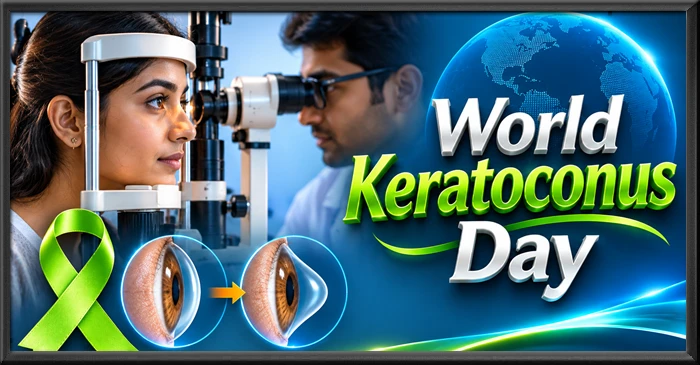
World Keratoconus Day is observed annually on November 10.
First internationally observed in 2016, the day was established by the National Keratoconus Foundation (NKCF).
It is to raise awareness of keratoconus, a progressive eye condition that thins and distorts the cornea.
It promotes early diagnosis, appropriate treatment, research, patient education, and support for people living with the condition worldwide.
World Keratoconus Day – History, Founder, Awareness and Significance
World Keratoconus Day, also known as World KC Day, is observed annually on November 10 to raise awareness of keratoconus, a progressive eye condition that changes the shape of the cornea and can significantly affect vision.
The international awareness observance was established by the National Keratoconus Foundation (NKCF), with its first international celebration documented on November 10, 2016.
World Keratoconus Day encourages early recognition, appropriate diagnosis, access to treatment, scientific research, and support for people affected by keratoconus.
History of World Keratoconus Day
Origin and Establishment – 2016
World Keratoconus Day originated from efforts by the National Keratoconus Foundation to improve public understanding of keratoconus.
The National Keratoconus Foundation was established in 1986 to provide information, patient support, and education concerning the condition.
In 2016, the foundation became an outreach programme of the Department of Ophthalmology at the University of California, Irvine.
The first international World Keratoconus Day was held on November 10, 2016.
The initiative aimed to bring together patients, families, eye-care professionals, researchers, and advocacy organisations to increase awareness and understanding of keratoconus.
The event also encouraged people living with the condition to share their experiences and educate others about its effects on everyday life.
Development of the International Observance
World Keratoconus Day developed into an annual awareness initiative involving eye-care institutions, ophthalmologists, optometrists, patient organisations, and volunteers.
The National Keratoconus Foundation continues to support and promote the observance through educational resources, awareness campaigns, patient stories, and professional collaboration.
The initiative highlights the importance of improved diagnostic techniques, appropriate management, research, and access to specialist eye care.
Who Founded World Keratoconus Day?
World Keratoconus Day was founded by the National Keratoconus Foundation (NKCF), a United States-based nonprofit educational organisation.
The foundation is associated with the Gavin Herbert Eye Institute at the University of California, Irvine.
NKCF promotes keratoconus awareness, patient education, medical research, and support services.
Although the organisation itself dates to 1986, World Keratoconus Day became an international awareness observance in 2016.
The annual event is an initiative of the foundation rather than the creation of a single officially identified individual.
What Is Keratoconus?
Keratoconus is a progressive eye condition affecting the cornea, the transparent, dome-shaped outer layer at the front of the eye.
In a healthy eye, the cornea has a relatively smooth, rounded surface that helps focus light.
In keratoconus, the cornea gradually becomes thinner and bulges outward into an irregular, cone-like shape.
This structural change prevents light from focusing properly on the retina, resulting in blurred or distorted vision.
The condition commonly affects both eyes, although its severity and progression may differ between them.
Keratoconus often develops during adolescence or early adulthood and may progress over several years.
What Causes Keratoconus?
The exact cause of keratoconus is not fully understood.
Researchers believe that genetic susceptibility and environmental factors contribute to its development.
Factors associated with keratoconus include:
- Family history of keratoconus.
- Frequent or excessive eye rubbing.
- Allergic eye conditions.
- Certain connective tissue disorders.
- Conditions associated with structural changes in corneal tissue.
These associations do not mean that every person with these factors will develop keratoconus.
Further research continues to investigate the biological mechanisms responsible for corneal thinning and disease progression.
Symptoms of Keratoconus
Keratoconus symptoms may initially resemble common refractive vision problems.
Possible signs and symptoms include:
- Blurred or distorted vision.
- Increased sensitivity to bright light and glare.
- Frequent changes in eyeglass prescriptions.
- Increasing astigmatism.
- Difficulty seeing clearly at night.
- Double or ghosted images, particularly in one eye.
- Difficulty wearing contact lenses comfortably.
- Progressive reduction in visual clarity.
Symptoms may develop gradually or worsen more quickly in some individuals.
Advanced keratoconus can cause corneal scarring and substantial visual impairment.
How Is Keratoconus Diagnosed?
Keratoconus is diagnosed through a comprehensive eye examination and specialised assessment of the cornea.
Corneal Topography
Corneal topography creates a detailed map of the cornea's surface curvature and helps identify irregularities associated with keratoconus.
Corneal Tomography
Corneal tomography provides additional information about the front and back surfaces of the cornea and its thickness.
Pachymetry
Pachymetry measures corneal thickness, which is important because thinning is a defining characteristic of keratoconus.
Slit-Lamp Examination
An ophthalmologist examines the cornea using a specialised microscope to identify structural changes and other signs of the condition.
Early detection is particularly important when the disease is progressing because treatment may help prevent further deterioration.
Treatment of Keratoconus
Treatment depends on the severity of keratoconus, the extent of corneal changes, and whether the condition is progressing.
Eyeglasses and Contact Lenses
In early stages, eyeglasses or soft contact lenses may provide satisfactory vision correction.
As the cornea becomes more irregular, specialised rigid gas-permeable or scleral contact lenses may be needed to improve visual clarity.
Corneal Cross-Linking
Corneal collagen cross-linking is a procedure that uses riboflavin eye drops and controlled ultraviolet-A light to strengthen corneal tissue.
It is primarily intended to slow or halt progression in suitable patients.
Intracorneal Ring Segments
Specialised implants may be used in selected patients to modify corneal shape and improve optical characteristics.
Corneal Transplantation
In advanced cases involving severe corneal scarring or inadequate vision despite other treatments, a corneal transplant may be considered.
An ophthalmologist determines the appropriate treatment based on individual clinical findings.
Objectives of World Keratoconus Day
The major objectives of World Keratoconus Day are:
- Raise global awareness of keratoconus.
- Encourage early recognition of corneal disorders.
- Promote access to appropriate diagnostic examinations.
- Educate patients about available management and treatment options.
- Support individuals and families affected by the condition.
- Encourage research into keratoconus causes and treatments.
- Strengthen collaboration among eye-care professionals and patient organisations.
- Improve public understanding of the daily challenges associated with impaired vision.
How Is World Keratoconus Day Observed?
World Keratoconus Day is marked through educational, advocacy, and community activities.
Eye Health Awareness Campaigns
Eye-care organisations share educational materials describing keratoconus, its symptoms, diagnosis, and management.
Educational Seminars
Ophthalmologists, optometrists, and researchers participate in educational discussions concerning corneal health.
Patient Experience Campaigns
People living with keratoconus share personal experiences to improve understanding and encourage others to seek appropriate eye care.
Eye Examination Initiatives
Some participating institutions organise screening opportunities, consultations, and eye-health education programmes.
Social Media Awareness
Organisations and individuals use hashtags such as #WorldKCDay and #NKCF to promote awareness.
Community Support
Patient groups provide educational resources, peer support, and information about specialist care.
World Keratoconus Day Awareness Ribbon
Lime green or chartreuse ribbons are used in keratoconus awareness activities.
The ribbon serves as a symbol of solidarity with individuals affected by the condition.
Supporters may wear awareness ribbons, participate in campaigns, and share educational information to encourage public discussion of keratoconus.
Importance of Early Diagnosis
Early diagnosis can improve the long-term management of keratoconus.
Because the condition often begins during adolescence or early adulthood, symptoms may initially be mistaken for ordinary nearsightedness or astigmatism.
Specialised corneal imaging can help identify abnormalities that may not be apparent during routine vision testing.
Identifying progressive disease allows ophthalmologists to consider treatment aimed at reducing further corneal deterioration.
Timely assessment is especially important for people with rapidly changing vision, a family history of keratoconus, or persistent symptoms.
Significance of World Keratoconus Day
World Keratoconus Day increases public understanding of a condition that can interfere with reading, driving, education, employment, and everyday activities.
The observance encourages people experiencing unexplained visual changes to seek professional evaluation.
It also provides opportunities for patient organisations and healthcare professionals to advocate for accessible diagnostic services, effective treatment, and continuing research.
The occasion is particularly significant because improved awareness and earlier clinical intervention can help preserve useful vision and improve quality of life.
Conclusion
World Keratoconus Day is observed annually on November 10 to promote keratoconus awareness, early diagnosis, treatment, research, and patient support.
Established by the National Keratoconus Foundation, the observance became an international awareness initiative in 2016.
The day highlights the importance of recognising corneal abnormalities, obtaining appropriate specialist care, and supporting people living with keratoconus.
References
- National Keratoconus Foundation – World KC Day
https://nkcf.org/world-kc-day/ - National Keratoconus Foundation – History
https://nkcf.org/history/ - University of California, Irvine – National Keratoconus Foundation
https://ophthalmology.uci.edu/community/national-keratoconus-foundation-nkcf - American Academy of Ophthalmology – What Is Keratoconus?
https://www.aao.org/eye-health/diseases/what-is-keratoconus - American Academy of Ophthalmology – Diagnosis and Management of Keratoconus
https://www.aao.org/eyenet/article/diagnosis-and-management-of-keratoconus - National Eye Institute – Corneal Dystrophies and Keratoconus
https://www.nei.nih.gov/eye-health-information/eye-conditions-and-diseases/corneal-conditions/corneal-dystrophies - Discovery Eye Foundation – World KC Day
https://discoveryeye.org/world-kc-day-november-10/
Also Read : World Samosa Day