

Date
- Date
- 10 Nov 2026
Time
- Time
- ...

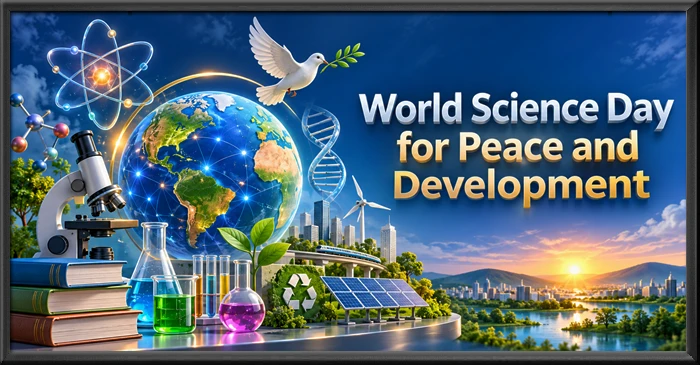
World Science Day for Peace and Development
World Science Day for Peace and Development is observed annually on 10 November.
Proclaimed by UNESCO in 2001 and first celebrated in 2002, the observance originated from the 1999 World Conference on Science in Budapest, Hungary.
It promotes scientific cooperation, public awareness, responsible use of scientific knowledge, peace, and sustainable development.
History of World Science Day for Peace and Development
The history of World Science Day for Peace and Development originated from the World Conference on Science, held in Budapest, Hungary, from 26 June to 1 July 1999.
The conference was organized by UNESCO in cooperation with the International Council for Science (ICSU).
It brought together representatives of governments, scientific institutions, researchers, and international organizations to discuss the relationship between science, society, and sustainable development.
The conference adopted two important documents:
- Declaration on Science and the Use of Scientific Knowledge
- Science Agenda – Framework for Action
These documents emphasized scientific responsibility, international cooperation, access to knowledge, and the role of science in addressing the needs of society.
One of the outcomes of the conference was the recognition that a dedicated annual international observance could help renew the commitments made in Budapest.
This proposal eventually led to the establishment of World Science Day for Peace and Development.
Establishment by UNESCO in 2001
World Science Day for Peace and Development was officially proclaimed by UNESCO during its 31st General Conference, held in Paris from 15 October to 3 November 2001.
Through Resolution 31 C/20, UNESCO designated 10 November as the annual date of the observance.
The resolution recognized that science influences peace and development and should be used to promote peaceful and sustainable societies.
It encouraged UNESCO Member States, international organizations, universities, research institutions, scientific associations, and schools to participate in the observance.
The establishment of World Science Day represented a commitment to bringing science closer to the public and strengthening the relationship between scientific research and societal needs.
First World Science Day for Peace and Development in 2002
The first World Science Day for Peace and Development was celebrated worldwide on 10 November 2002, under UNESCO's auspices.
The inaugural observance involved numerous organizations and institutions, including governments, research centers, professional associations, educational institutions, nongovernmental organizations, and the media.
Its purpose was to increase public understanding of science and highlight scientific cooperation as a means of promoting peace and development.
Since its establishment, the observance has encouraged educational activities, scientific discussions, institutional cooperation, and initiatives supporting the use of science for the benefit of society.
Why Is World Science Day Celebrated on November 10?
World Science Day for Peace and Development is celebrated on November 10 because UNESCO formally selected that date through its 2001 proclamation.
The annual observance provides an opportunity to renew international commitments to the responsible application of science.
It also connects the principles of the 1999 World Conference on Science with public awareness and scientific cooperation.
November 10 serves as a reminder that scientific progress should be accompanied by ethical responsibility, public engagement, and international collaboration.
Objectives of World Science Day for Peace and Development
According to UNESCO, World Science Day for Peace and Development has four principal objectives.
1. Strengthening Public Awareness
The observance aims to increase public awareness of the importance of science in building peaceful and sustainable societies.
It encourages people to understand how scientific research influences health, education, technology, environmental protection, and everyday life.
2. Promoting International Scientific Cooperation
World Science Day supports cooperation between nations and scientific communities.
It emphasizes the importance of sharing scientific knowledge, research findings, and technological expertise to address common challenges.
3. Renewing Commitment to Responsible Science
The day encourages governments, institutions, and researchers to renew their commitment to using science for the benefit of humanity.
Scientific advancement should promote social well-being, environmental sustainability, and responsible development.
4. Supporting Scientific Research
The observance draws attention to challenges faced by scientific communities and highlights the need for sustained support for research.
It recognizes the importance of scientific education, research infrastructure, and opportunities for scientists to contribute to society.
Role of Science in Promoting Peace
Science can contribute to peace by supporting cooperation, mutual understanding, and practical solutions to problems shared across national boundaries.
Scientific research often requires collaboration among people from different cultural, political, and geographical backgrounds.
International research partnerships can create opportunities for dialogue, shared learning, and cooperation.
Scientific knowledge also helps societies address challenges involving clean water, food security, infectious diseases, environmental protection, and natural disasters.
Addressing these challenges can contribute to human security and reduce pressures that may increase social instability.
UNESCO has highlighted the Israeli-Palestinian Science Organization as an example of an initiative intended to foster scientific cooperation across communities affected by conflict.
Although science alone cannot resolve political conflicts, responsible scientific collaboration can support broader efforts toward peaceful development.
Science and Sustainable Development
Science plays an important role in achieving sustainable development.
Scientific research helps societies understand environmental problems, improve resource management, develop technologies, and evaluate development policies.
Climate Change and Environmental Protection
Climate science provides evidence about changes in Earth's climate system.
Scientific findings support environmental monitoring, climate adaptation, biodiversity protection, and the development of cleaner energy technologies.
Public Health and Medicine
Medical research contributes to disease prevention, diagnosis, treatment, vaccination, and public health planning.
Scientific cooperation enables researchers and health institutions to exchange knowledge and respond to health challenges.
Food Security and Agriculture
Agricultural science supports crop improvement, soil conservation, irrigation efficiency, and sustainable farming methods.
Research helps communities improve food production while reducing environmental pressures.
Clean Energy and Technology
Scientific advances contribute to renewable energy systems, energy efficiency, and technological innovation.
These developments can support economic growth while helping societies reduce environmental harm.
Disaster Risk Reduction
Research in meteorology, geology, and environmental science supports early-warning systems and disaster preparedness.
Scientific information helps governments and communities understand risks and make informed decisions.
Importance of Science Education and Public Awareness
World Science Day for Peace and Development highlights the importance of science education in developing informed societies.
Scientific literacy helps people evaluate evidence, understand technological developments, and participate in public discussions.
Schools, universities, and research institutions play important roles in promoting scientific knowledge.
Public lectures, exhibitions, science festivals, educational programmes, and interactive demonstrations can make scientific concepts more accessible.
The observance also encourages young people to explore careers in science, technology, engineering, and mathematics.
Improving access to scientific education can help expand opportunities for communities that face barriers to participation in research and innovation.
Science, Ethics and Social Responsibility
Scientific advancement brings both opportunities and responsibilities.
New technologies can improve living standards, but their development and application may also raise ethical, environmental, and social concerns.
Responsible science requires research integrity, transparency, careful evaluation of risks, and consideration of the public interest.
Scientific institutions have a responsibility to communicate research findings accurately and acknowledge uncertainty.
Governments and other decision-makers should consider reliable scientific evidence when developing policies.
Public participation in scientific discussions is important because scientific decisions can affect communities, economies, and the environment.
World Science Day encourages a stronger relationship between scientists and society, emphasizing that scientific progress should serve humanity.
How Is World Science Day for Peace and Development Observed?
World Science Day for Peace and Development is observed through activities organized by educational institutions, scientific organizations, government agencies, and community groups.
Common activities include:
- Scientific exhibitions and demonstrations.
- Public lectures and educational seminars.
- School and university science competitions.
- Discussions about science, peace, and sustainable development.
- Workshops on environmental protection and scientific literacy.
- Programmes encouraging young people to pursue scientific careers.
- International scientific cooperation and knowledge-sharing initiatives.
The activities vary between countries and organizations, but their central objective is to strengthen public engagement with science.
World Science Day and International Scientific Cooperation
International cooperation is a central principle of World Science Day for Peace and Development.
Scientific challenges frequently extend beyond national borders.
Climate change, infectious diseases, biodiversity loss, and environmental pollution require knowledge-sharing and coordinated responses.
Cooperation between scientific institutions allows researchers to exchange data, compare findings, and develop solutions.
UNESCO promotes scientific collaboration through programmes involving research, education, scientific capacity-building, and the exchange of knowledge.
World Science Day reinforces the idea that scientific knowledge can serve as a shared resource for humanity.
Historical Significance of World Science Day for Peace and Development
The historical significance of World Science Day for Peace and Development lies in its recognition of science as an essential component of peaceful and sustainable societies.
Its establishment connected the commitments of the 1999 Budapest World Conference on Science with an annual international observance.
The UNESCO proclamation in 2001 marked an institutional commitment to strengthening cooperation between scientists, governments, and the public.
The first celebration in 2002 provided an international platform for recognizing the contributions of science to social and economic progress.
The observance also emphasizes that the benefits of scientific research should be accessible to societies worldwide.
Through its focus on public awareness, ethical responsibility, and cooperation, World Science Day has become an important international occasion for discussing the relationship between science and humanity.
Conclusion
World Science Day for Peace and Development, observed annually on November 10, recognizes the essential role of science in promoting peace, international cooperation, and sustainable development.
Proclaimed by UNESCO in 2001 and first celebrated in 2002, the observance originated from the commitments made at the 1999 World Conference on Science in Budapest.
Its objectives include strengthening scientific awareness, encouraging responsible research, supporting international cooperation, and promoting the use of scientific knowledge for the benefit of humanity.
The observance highlights the enduring importance of connecting scientific progress with the needs of society.
References
- UNESCO – World Science Day for Peace and Development
https://www.unesco.org/en/days/science-peace-development - United Nations – World Science Day for Peace and Development
https://www.un.org/en/observances/world-science-day - UNESCO – Records of the 31st General Conference, Resolution 20 (2001)
https://unesdoc.unesco.org/ark:/48223/pf0000124687 - United Nations – World Science Day for Peace and Development, 10 November
https://www.un.org/en/node/84041 - UNESCO – World Science Day for Peace and Development: Science for and with Society
https://www.unesco.org/en/articles/world-science-day-peace-and-development - United Nations – International Days and Weeks
https://www.un.org/observances/list-days-weeks - UNESCO – World Science Day for Peace and Development: Why Science Matters
https://www.unesco.org/en/articles/world-science-day-peace-and-development-why-science-matters-engaging-minds-and-empowering-futures
Also Read : International Women’s Day for Peace and Disarmament