

Date
- Date
- 9 Nov 2026
Time
- Time
- ...

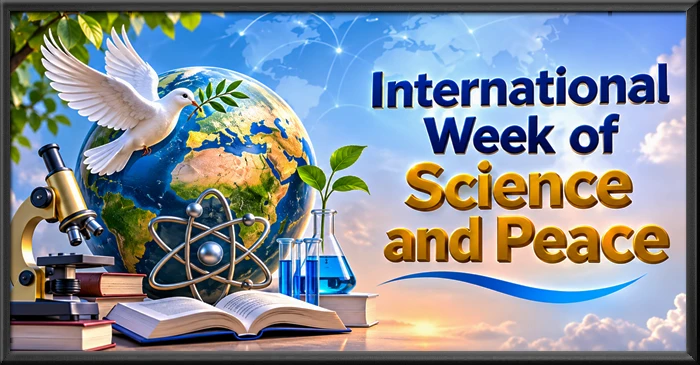
International Week of Science and Peace
International Week of Science and Peace is observed annually during the week containing 11 November, listed as 9–15 November on the UN calendar.
First observed in 1986 during the International Year of Peace, it was officially proclaimed by the United Nations General Assembly on 6 December 1988 through Resolution 43/61 to promote scientific cooperation, peace, and international security.
International Week of Science and Peace – History, Origin, Objectives and Significance
Introduction
The International Week of Science and Peace highlights the relationship between scientific advancement, international security, cooperation, and the well-being of humanity.
The observance encourages scientists, universities, research institutions, governments, and international organizations to examine how scientific knowledge can help prevent conflicts and promote peaceful development.
It also draws attention to the responsibilities of scientific communities in ensuring that research and technological progress contribute positively to society.
Historical Background of the International Week of Science and Peace
The origins of the International Week of Science and Peace can be traced to international initiatives promoting the peaceful applications of scientific knowledge.
During the twentieth century, developments in nuclear technology, military research, communications, and industrial technology raised important questions about the relationship between science and international security.
Scientific research created opportunities for economic development, medical progress, and technological advancement while also contributing to the development of increasingly destructive weapons.
These developments encouraged scientists and international organizations to discuss the ethical responsibilities of research and the importance of cooperation across national boundaries.
The idea of organizing an international week dedicated to science and peace emerged from these concerns.
The First International Week of Scientists for Peace in 1986
The earliest documented celebration was known as the International Week of Scientists for Peace.
It took place from 10 to 16 November 1986 as part of the United Nations International Year of Peace.
According to the United Nations Yearbook, an international association of scientists proposed the initiative to encourage the peaceful use of scientific progress and promote human well-being.
The activities were organized through a nongovernmental initiative rather than an official United Nations observance.
Organizers informed the secretariat responsible for the International Year of Peace about their preparations and the activities conducted.
The initiative encouraged scientists and interested organizations to participate in discussions concerning the relationship between scientific development and peace.
Its success provided the foundation for subsequent international observances.
The Second Observance in 1987
A second International Week of Scientists for Peace was organized from 9 to 15 November 1987.
The continuation of the initiative demonstrated growing interest in the relationship between scientific knowledge and international security.
The organizers sought broader international participation and greater cooperation between scientific institutions.
The first two observances helped establish the case for a permanent annual international event.
Their significance was subsequently acknowledged during discussions at the United Nations General Assembly.
United Nations Recognition in 1988
The International Week of Science and Peace received formal United Nations recognition on 6 December 1988.
On that date, the United Nations General Assembly adopted Resolution 43/61, titled Science and Peace, without a vote.
The resolution officially proclaimed the International Week of Science and Peace as an annual international observance.
It recognized that scientific and technological progress can influence international peace, security, social and economic development, human rights, and environmental protection.
The General Assembly also emphasized the importance of dialogue between scientists, political leaders, and the wider public.
The proclamation marked the transition from an independently organized scientific initiative to an internationally recognized observance supported by the United Nations.
When Is the International Week of Science and Peace Observed?
The United Nations General Assembly established the observance for the week in which November 11 falls.
This rule was recorded in Resolution 43/61.
The United Nations observance calendar also lists November 9–15 as the annual period.
Historically, the first celebration took place from November 10 to 16, 1986, while the second was held from November 9 to 15, 1987.
These dates illustrate the distinction between the original observances and the subsequent calendar listing.
The essential historical requirement established by the General Assembly is that the annual observance includes November 11.
Objectives of the International Week of Science and Peace
1. Promote Scientific Cooperation
The observance encourages researchers and scientific institutions to collaborate across national borders.
International partnerships can facilitate the exchange of knowledge, expertise, and research findings.
2. Strengthen International Peace and Security
Scientific knowledge can assist countries in understanding security challenges and identifying peaceful solutions.
The observance promotes research and dialogue concerning the contributions of science to peace.
3. Encourage Responsible Scientific Development
Scientific discoveries can be applied for beneficial or harmful purposes.
The week encourages greater awareness of the social, environmental, and security consequences of scientific and technological progress.
4. Support Dialogue Between Scientists and Society
The United Nations resolution emphasizes open discussion involving scientists, political leaders, and the general public.
Such dialogue helps societies understand the potential consequences of scientific developments.
5. Promote Public Awareness
Educational activities and public discussions help explain the connection between scientific research, international cooperation, and human welfare.
The observance encourages individuals and institutions to consider the responsibilities associated with technological advancement.
Science and International Peace
Scientific cooperation can help build relationships between countries and communities with different political and cultural backgrounds.
Joint research programmes create opportunities for exchanging ideas, establishing professional relationships, and addressing shared challenges.
Scientific collaboration is particularly important in fields where problems extend beyond national boundaries.
Examples include environmental monitoring, public health, disaster preparedness, and the management of shared natural resources.
Research can provide information that supports informed decision-making and constructive international dialogue.
However, science alone cannot guarantee peace.
Political decisions, international agreements, human rights protections, and diplomatic cooperation remain essential.
The International Week of Science and Peace emphasizes the potential contribution of scientific knowledge within these broader efforts.
Science, Disarmament and Global Security
The relationship between science and disarmament was an important concern behind the United Nations proclamation.
Technological advances have contributed to the development of weapons and military systems with serious implications for international security.
At the same time, scientific research can assist arms control, monitoring, verification, and risk assessment.
The United Nations General Assembly recognized the value of examining how scientific progress affects peace and security.
Resolution 43/61 encouraged activities that would improve public understanding of these relationships.
It also promoted international scientific cooperation and dialogue about the implications of technological development.
Role of Universities and Scientific Institutions
Universities, research organizations, scientific academies, and professional associations have important roles in the observance.
Resolution 43/61 specifically encouraged these institutions to conduct educational and professional activities addressing science and peace.
Universities can organize lectures examining the historical relationship between scientific progress and international cooperation.
Research institutions may facilitate discussions about scientific ethics, security challenges, and environmental protection.
Professional associations can encourage international collaboration and the responsible communication of scientific findings.
These activities help connect scientific research with broader social responsibilities.
How Is the International Week of Science and Peace Observed?
Activities associated with the observance vary between institutions and countries.
They may include:
- Scientific seminars examining international peace and security.
- University lectures about scientific ethics and social responsibility.
- Discussions on disarmament and the peaceful application of technology.
- International exchanges of scientific information and expertise.
- Educational programmes explaining the social consequences of scientific progress.
- Research collaborations addressing common global challenges.
- Public awareness initiatives emphasizing the contribution of science to human well-being.
The United Nations encourages participation by governments, international organizations, educational institutions, and individuals within the scientific community.
International Week of Science and Peace and World Science Day
The International Week of Science and Peace should not be confused with World Science Day for Peace and Development.
Although both observances highlight the importance of science for humanity, they have different historical origins.
The International Week of Science and Peace emerged from scientist-led activities in 1986 and received official United Nations recognition in 1988.
World Science Day for Peace and Development was proclaimed by UNESCO in 2001 and first celebrated in 2002.
World Science Day is observed annually on November 10, whereas the International Week of Science and Peace covers a week in November.
The two observances complement one another by encouraging scientific awareness, international cooperation, and the responsible use of knowledge.
Historical Significance
The International Week of Science and Peace represents an important development in the relationship between scientific communities and international peace initiatives.
Its origins demonstrate how a nongovernmental initiative can develop into a formally recognized United Nations observance.
The 1986 and 1987 activities established the foundation for international participation.
The 1988 General Assembly proclamation provided an institutional framework for encouraging scientific dialogue and cooperation.
The observance also reflects the growing recognition that scientific advancement has consequences extending beyond laboratories and research institutions.
Its historical importance lies in promoting the view that scientific progress should contribute to peaceful development, human security, and international understanding.
Conclusion
The International Week of Science and Peace recognizes the responsibilities and potential contributions of scientific communities in building a more peaceful world.
Through its emphasis on ethical research, cooperation, public awareness, and international security, the observance connects scientific development with the broader interests of humanity.
Its historical development from a nongovernmental initiative to a United Nations observance demonstrates the importance of collaboration between researchers, institutions, and international organizations.
The week continues to represent the principle that scientific knowledge should be used responsibly and directed toward the well-being of society.
References
- United Nations – International Week of Science and Peace
https://www.un.org/en/observances/international-week-science-and-peace - United Nations – International Week of Science and Peace: Historical Background
https://www.un.org/en/observances/world-science-day/week - United Nations Digital Library – General Assembly Resolution 43/61: Science and Peace
https://digitallibrary.un.org/record/54151 - United Nations – Yearbook of the United Nations 1988
https://digitallibrary.un.org/record/232318 - United Nations – World Science Day for Peace and Development
https://www.un.org/en/observances/world-science-day - United Nations – International Year of Peace: Historical Background
https://www.un.org/en/peaceandsecurity/the-history-of-the-international-day-of-peace
Also Read : Lesbian Visibility Week