

Date
- Date
- 22 Nov 2026
Time
- Time
- ...
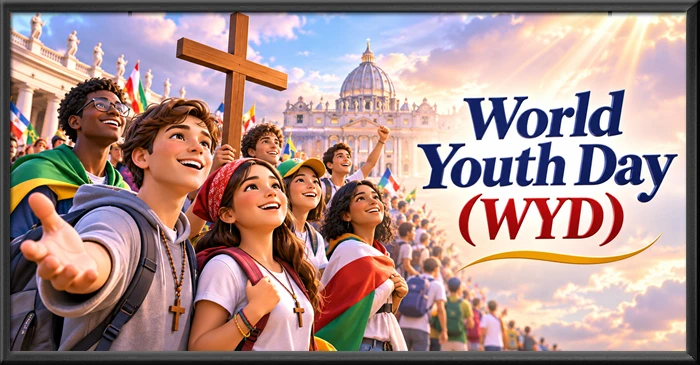
World Youth Day (WYD)
World Youth Day (WYD) is observed annually on the Solemnity of Christ the King.
Established by Pope John Paul II on 20 December 1985 and first celebrated on 23 March 1986, this Catholic observance promotes youth faith and fellowship.
Originally held on Palm Sunday, its annual diocesan celebration moved to Christ the King Sunday in 2021.
World Youth Day (WYD) – History, Origin, Founder and Significance
Introduction
World Youth Day (WYD) is one of the most significant international Catholic youth initiatives, bringing together young people for prayer, pilgrimage, religious education, and spiritual fellowship.
The observance developed from large youth gatherings in Rome during the 1980s and became an established feature of Catholic youth ministry.
Its history reflects the efforts of Pope John Paul II to strengthen the relationship between young Catholics, their local churches, and the wider international Catholic community.
World Youth Day (WYD) consists of annual celebrations in local churches and periodic international gatherings hosted by different cities.
Historical Background of World Youth Day (WYD)
The origins of Catholic World Youth Day (WYD) can be traced to the early 1980s, when Pope John Paul II encouraged greater participation by young people in the life of the Catholic Church.
During this period, the Church organized major gatherings that brought together young Catholics from different countries.
The Jubilee of Young People during the Holy Year of Redemption became particularly important in shaping the idea of an international youth observance.
The response to these gatherings demonstrated the possibilities of creating a recurring event focused on Catholic youth.
The initiative subsequently developed into a formally established annual observance.
The 1984 International Youth Gathering in Rome
One of the most important predecessors of World Youth Day took place in Rome in April 1984.
The gathering was associated with the Holy Year of Redemption and brought large numbers of young Catholics to Saint Peter's Square.
On Palm Sunday, 15 April 1984, Pope John Paul II welcomed young people participating in the international celebration.
A particularly important development occurred on 22 April 1984, when he entrusted a large wooden cross to young people.
The cross subsequently became known as the World Youth Day Cross, Pilgrim Cross, or Jubilee Cross.
It became one of the most recognizable symbols associated with the international youth initiative.
The 1984 gathering demonstrated the potential for large-scale religious meetings involving young people from different nations.
International Youth Gathering of 1985
Another major gathering took place in Rome on Palm Sunday, 31 March 1985.
The event coincided with the United Nations International Youth Year.
Approximately 300,000 young people participated in the gathering, according to Vatican historical records.
Pope John Paul II addressed the participants and encouraged young Catholics to strengthen their commitment to Christian faith and community.
The successful gatherings of 1984 and 1985 were decisive in the development of a recurring Catholic youth observance.
They provided the immediate historical foundation for the formal establishment of World Youth Day.
Pope John Paul II Established World Youth Day in 1985
Pope John Paul II formally announced the institution of World Youth Day on 20 December 1985.
The announcement followed the two major international youth gatherings previously held in Rome.
His intention was to strengthen the Catholic Church's engagement with young people and provide recurring opportunities for spiritual formation, fellowship, and participation.
The new observance was designed to take place annually in Catholic dioceses.
It was originally associated with Palm Sunday, a significant date in the Christian liturgical calendar.
The decision established a permanent framework for the Church's international youth initiative.
Pope John Paul II is therefore recognized as the founder of Catholic World Youth Day.
The First Official World Youth Day in 1986
The first official World Youth Day took place on 23 March 1986, Palm Sunday.
The inaugural observance was organized at the diocesan level, including the celebration in Rome.
The event emphasized Christian hope and encouraged young people to understand and communicate their religious beliefs.
Its biblical theme was based on 1 Peter 3:15, concerning readiness to explain the hope associated with Christian faith.
The first celebration established the pattern of annual World Youth Day observances.
Although major international gatherings later became the best-known feature of WYD, the original annual diocesan celebrations remained central to its identity.
The First International World Youth Day in Buenos Aires
The first international World Youth Day gathering after the institution of the observance took place in Buenos Aires, Argentina, on 11–12 April 1987.
This event was designated the second World Youth Day in the official chronology.
It brought together large numbers of young Catholics from different countries.
The gathering represented an important step in transforming WYD from an annual diocesan observance into an international pilgrimage tradition.
Buenos Aires established a model in which major international gatherings could be hosted outside Rome.
This approach subsequently allowed Catholics from different regions to participate in the observance through international travel and shared religious activities.
World Youth Day Annual Date – Palm Sunday to Christ the King
The original annual World Youth Day celebrations were associated with Palm Sunday.
Palm Sunday commemorates the entry of Jesus Christ into Jerusalem and marks the beginning of Holy Week in the Christian calendar.
The connection between Palm Sunday and youth gatherings was established during the original events that preceded the institution of WYD.
Change Announced by Pope Francis in 2020
On 22 November 2020, Pope Francis announced a change to the annual date for diocesan World Youth Day celebrations.
He transferred the local observance from Palm Sunday to the Solemnity of Our Lord Jesus Christ, King of the Universe, commonly called Christ the King Sunday.
The change took effect in 2021.
Christ the King Sunday occurs on the final Sunday of the Catholic liturgical year in the Roman Rite, immediately before Advent.
Consequently, its calendar date changes annually.
The Vatican's 2021 pastoral guidelines also acknowledge that local Church authorities may choose another date when pastoral circumstances require it.
International World Youth Day Dates
The international gatherings follow a different scheduling arrangement.
They are organized periodically in host countries and take place on dates determined by the Church and the organizing authorities.
Therefore, the annual diocesan observance and international WYD gatherings should not be treated as having an identical fixed date.
Objectives of World Youth Day
Strengthening Christian Faith
A principal objective of WYD is to provide young Catholics with opportunities to deepen their understanding of Christianity.
Religious education, prayer, worship, and reflection are central to the gatherings.
Encouraging Youth Participation
The initiative recognizes young people as active participants in the Catholic Church.
It encourages them to contribute to religious, educational, and community activities.
Promoting International Fellowship
International gatherings bring together participants from different countries, languages, and cultures.
These encounters provide opportunities for cultural exchange and cooperation within the global Catholic community.
Supporting Spiritual Formation
World Youth Day emphasizes personal reflection, religious commitment, and participation in the sacraments.
It also encourages young Catholics to consider the relationship between faith and their responsibilities in society.
Building Catholic Community
The observance promotes relationships between young people, local parishes, dioceses, and international Catholic institutions.
Its activities help connect local youth ministry with the wider Church.
The World Youth Day Cross
The World Youth Day Cross is one of the principal symbols associated with the observance.
Pope John Paul II entrusted the cross to young people on 22 April 1984.
The wooden cross subsequently travelled between countries and dioceses as a symbol of Christian faith.
Its journeys became closely associated with preparations for international World Youth Day gatherings.
Young Catholics participated in processions, prayer services, and public religious events connected with the travelling cross.
The symbol reflects the central place of Jesus Christ's crucifixion and resurrection in Catholic theology.
Icon of the Virgin Mary
Another important World Youth Day symbol is the icon of the Virgin Mary known as Salus Populi Romani.
In 2003, Pope John Paul II entrusted a Marian icon to young people as a companion to the World Youth Day Cross.
The two symbols subsequently travelled together during preparations for international gatherings.
The icon emphasizes the place of Mary in Catholic spirituality and the religious traditions associated with World Youth Day.
Together, the cross and icon became recognizable symbols of the observance's international pilgrimage tradition.
Notable International World Youth Day Gatherings
The history of World Youth Day includes several major international celebrations.
| Year | Host City | Country |
|---|---|---|
| 1987 | Buenos Aires | Argentina |
| 1989 | Santiago de Compostela | Spain |
| 1991 | Częstochowa | Poland |
| 1993 | Denver | United States |
| 1995 | Manila | Philippines |
| 1997 | Paris | France |
| 2000 | Rome | Italy |
| 2002 | Toronto | Canada |
| 2005 | Cologne | Germany |
| 2008 | Sydney | Australia |
| 2011 | Madrid | Spain |
| 2013 | Rio de Janeiro | Brazil |
| 2016 | Kraków | Poland |
| 2019 | Panama City | Panama |
| 2023 | Lisbon | Portugal |
These gatherings illustrate the geographical expansion of World Youth Day and its development as an international Catholic institution.
The events have featured religious services, educational programmes, public addresses, cultural activities, and meetings involving the Pope.
How Is World Youth Day Celebrated?
World Youth Day activities vary according to whether the event is a local diocesan observance or an international gathering.
Common activities include:
- Catholic Mass and other liturgical celebrations.
- Prayer services and religious reflection.
- Catechesis and educational sessions.
- Youth meetings and discussions.
- Pilgrimages and processions.
- Cultural exchanges and community activities.
- Meetings with bishops, priests, and other Catholic leaders.
- Volunteer programmes and community service.
International gatherings generally involve extensive planning by local dioceses, national Church organizations, and the Vatican.
Local celebrations are usually smaller and adapted to the needs of individual Catholic communities.
World Youth Day and Catholic Youth Ministry
World Youth Day has played an important role in the development of Catholic youth ministry.
The initiative creates opportunities for local churches to communicate with young people and understand their concerns.
The Vatican's pastoral guidelines emphasize that young people should be active participants rather than passive recipients of religious programmes.
The annual diocesan observance is particularly important because not every young person can travel to an international gathering.
Local celebrations provide more accessible opportunities for participation in Catholic youth activities.
This structure allows World Youth Day to maintain both a local and international identity.
World Youth Day (WYD) vs World Youth Day (WFDY)
Catholic World Youth Day should not be confused with World Youth Day associated with the World Federation of Democratic Youth.
Despite sharing the same English name, the two observances have separate founders, historical backgrounds, objectives, and dates.
| Feature | Catholic World Youth Day | WFDY World Youth Day |
|---|---|---|
| Founder / Origin | Pope John Paul II | World Federation of Democratic Youth |
| Established / Associated Origin | 1985 | 1945 |
| Annual Observance | Christ the King Sunday | November 10 |
| Historical Background | Catholic youth gatherings | Post-Second World War youth movements |
| Principal Focus | Christian faith and youth fellowship | Youth solidarity, peace, and political engagement |
Catholic WYD is a religious observance, whereas the WFDY-associated occasion developed from international youth movements active after the Second World War.
The two observances are not affiliated.
World Youth Day vs United Nations International Youth Day
World Youth Day is also distinct from the United Nations International Youth Day.
The UN observance takes place annually on August 12.
It was established through United Nations General Assembly Resolution 54/120 in 1999.
International Youth Day addresses youth-related challenges, participation, development, and opportunities across societies.
Catholic World Youth Day has a religious origin and focuses on Christian faith and community.
Although both recognize young people, their institutional identities and objectives are different.
Historical Significance of World Youth Day
World Youth Day represents an important development in modern Catholic history.
Its establishment reflected Pope John Paul II's commitment to involving young people more actively in the Church.
The initiative also contributed to the growth of international Catholic youth pilgrimages.
Its expansion into different countries created opportunities for interaction among Catholic communities across linguistic and cultural boundaries.
The transfer of the annual diocesan observance to Christ the King Sunday demonstrated how the tradition continued to develop after its original establishment.
The World Youth Day Cross, Marian icon, international gatherings, and local celebrations have become lasting elements of its historical identity.
Conclusion
Catholic World Youth Day is a major international religious observance associated with Pope John Paul II and the development of modern Catholic youth ministry.
Its history encompasses the early Rome gatherings, the formal institution of the observance, its first diocesan celebrations, and the subsequent international pilgrimages.
The observance's significance lies in its contribution to religious education, youth participation, Catholic fellowship, and international spiritual exchange.
Its historical identity remains distinct from the World Federation of Democratic Youth's November observance and the United Nations International Youth Day.
References
- Vatican – Chronicle of World Youth Days
https://www.vatican.va/gmg/documents/gmg_chronicle-wyd_20020325_en.html - Dicastery for Laity, Family and Life – World Youth Day (WYD)
https://www.laityfamilylife.va/content/laityfamilylife/en/giovani/gmg.4.html - Vatican – Pastoral Guidelines for the Celebration of World Youth Day (WYD) in Particular Churches (2021)
https://press.vatican.va/content/salastampa/en/bollettino/pubblico/2021/05/18/210518a.html - Vatican – Press Conference on World Youth Day (WYD) Guidelines (2021)
https://press.vatican.va/content/salastampa/en/bollettino/pubblico/2021/05/18/210518b.html - Dicastery for Laity, Family and Life – The Youth Cross
https://www.laityfamilylife.va/content/laityfamilylife/en/giovani/pastorale-giovanile/il-pellegrinaggio-della-croce-dei-giovani.html - United States Conference of Catholic Bishops – World Youth Day (WYD) FAQs
https://www.usccb.org/topics/world-youth-day/world-youth-day-frequently-asked-questions - WorldYouthDay.com – About World Youth Day (WYD)
https://worldyouthday.com/about-wyd/ - WorldYouthDay.com – History of World Youth Day (WYD)
https://worldyouthday.com/about-wyd/wyd-history/
Also Read : World Youth Skills Day