

Date
- Date
- 11 Nov 2026
Time
- Time
- ...
Armistice Day
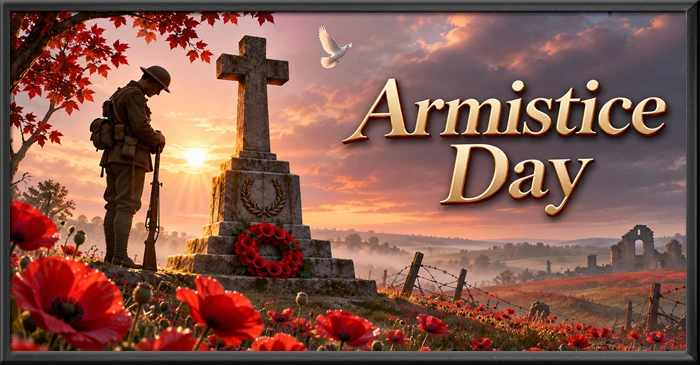
Armistice Day is observed annually on November 11 in several countries worldwide.
First commemorated in 1919, the observance marks the armistice that ended major fighting on the Western Front of World War I at 11 a.m. on November 11, 1918.
It honours those affected by war and promotes remembrance, peace, and reflection on military sacrifice.
Armistice Day – History, Origin, Date and Significance
Armistice Day is observed annually on November 11 to commemorate the armistice that brought major fighting on the Western Front of the First World War to an end in 1918.
The agreement came into effect at 11:00 a.m. on November 11, 1918, giving rise to the historic expression "the eleventh hour of the eleventh day of the eleventh month."
First commemorated in 1919, Armistice Day became an important occasion for remembering military personnel who died during the war and reflecting on the importance of peace.
The observance continues in countries including the United Kingdom, France, and Belgium, although national names, ceremonies, and public holiday arrangements differ.
History of Armistice Day
The First World War – 1914 to 1918
The First World War began in 1914 and developed into a major international conflict involving European powers and countries from other parts of the world.
The war caused enormous military and civilian casualties, widespread destruction, and profound political and social changes.
Fighting on the Western Front was particularly devastating, involving prolonged trench warfare, artillery bombardments, and large-scale military operations.
By 1918, Germany and its allies faced increasingly serious military and political difficulties.
As the situation deteriorated, negotiations began to bring the fighting to an end.
Signing of the Armistice – November 11, 1918
The armistice between Germany and the Allied powers was signed during the early morning of November 11, 1918, in a railway carriage in the Forest of Compiègne, France.
Marshal Ferdinand Foch represented the Allied military command, while Matthias Erzberger headed the German delegation.
The agreement established terms for suspending hostilities between Germany and the Allied forces.
The armistice took effect at precisely 11:00 a.m. on November 11, 1918.
The cessation of major fighting on the Western Front marked a decisive turning point in the First World War.
However, the armistice was a military agreement suspending hostilities, not a final peace treaty.
The Treaty of Versailles, signed on June 28, 1919, subsequently established peace terms between Germany and the Allied powers.
First Armistice Day – November 11, 1919
The first anniversary of the armistice was commemorated on November 11, 1919.
The occasion became known as Armistice Day.
In Britain, King George V called for a two-minute silence at 11:00 a.m. to remember those who had died during the war.
The silence allowed people to stop their ordinary activities and reflect on military sacrifice and the human consequences of conflict.
In the United States, President Woodrow Wilson proclaimed November 11, 1919, as the first national commemoration of Armistice Day.
Other Allied countries also developed their own commemorative traditions.
Over time, November 11 became widely associated with remembrance, reconciliation, and peace.
Who Founded Armistice Day?
Armistice Day did not originate from a single internationally recognised founder.
Its development followed the end of the First World War and involved national governments, veterans' organisations, community groups, and political leaders.
Several individuals played important historical roles.
King George V
King George V helped establish the British tradition of observing two minutes of silence at 11:00 a.m. on November 11, 1919.
The practice became an enduring feature of remembrance ceremonies in Britain and other Commonwealth countries.
Woodrow Wilson
United States President Woodrow Wilson proclaimed the first American Armistice Day commemoration in November 1919.
The occasion was intended to honour American service members and express hopes for peace following the war.
Ferdinand Foch
Marshal Ferdinand Foch was the Allied commander associated with the November 1918 armistice negotiations.
His historical role concerns the military agreement rather than the later founding of Armistice Day as a commemorative observance.
Therefore, Armistice Day should be described as a commemoration that developed internationally after 1918, rather than an observance established by one individual.
Why Is Armistice Day Observed on November 11?
Armistice Day is observed on November 11 because the First World War armistice came into effect at 11:00 a.m. on that date in 1918.
The timing gave the occasion its symbolic association with the number eleven.
The date was retained for annual commemorations because it marked the cessation of major fighting on the Western Front.
The anniversary became an occasion to remember those who had died, recognise the effects of warfare, and express hopes for lasting peace.
Armistice Day in Different Countries
United Kingdom
The United Kingdom observes Armistice Day on November 11.
At 11:00 a.m., a two-minute silence is commonly observed at war memorials, public institutions, workplaces, and community gatherings.
The Royal British Legion supports remembrance activities and educational initiatives.
The United Kingdom also observes Remembrance Sunday on the second Sunday of November.
Although closely connected, Armistice Day and Remembrance Sunday are not always the same calendar date.
France
France commemorates the armistice of November 11, 1918, as a national public holiday.
A law enacted on October 24, 1922, formally established November 11 as a day commemorating victory and peace.
National ceremonies are held at war memorials, including the Tomb of the Unknown Soldier beneath the Arc de Triomphe in Paris.
Since 2012, the November 11 commemoration has also honoured all those who died for France, extending its commemorative scope beyond the First World War.
Belgium
Belgium observes November 11 as Armistice Day, a statutory public holiday.
The occasion commemorates the end of major fighting in 1918 and honours those who lost their lives in military conflicts.
Commemorative ceremonies are held at memorials and historic sites associated with the First World War.
United States
The United States originally observed November 11 as Armistice Day.
President Woodrow Wilson initiated the first national commemoration in 1919.
The occasion became a federal holiday in 1938.
On June 1, 1954, President Dwight D. Eisenhower signed legislation renaming Armistice Day as Veterans Day.
The modern American holiday honours people who served in the United States Armed Forces.
Australia
Australia originally observed the anniversary as Armistice Day.
Following the Second World War, the occasion became known as Remembrance Day.
It continues to be observed annually on November 11, with a period of silence at 11:00 a.m.
Armistice Day and the Two-Minute Silence
One of the most recognisable traditions associated with Armistice Day is the two-minute silence.
The practice was introduced in 1919.
King George V called for public activities to stop at the eleventh hour so people could remember those who died in the First World War.
The tradition was influenced by earlier silence ceremonies in South Africa and proposals by individuals including Sir Percy FitzPatrick and Edward George Honey.
The two-minute silence remains an important remembrance custom in the United Kingdom and several other countries.
Some countries observe one minute rather than two, depending on national traditions.
Why Are Red Poppies Associated With Armistice Day?
Red poppies are widely associated with remembrance of military personnel who died in war.
During the First World War, poppies grew on battlefields in northern France and Belgium.
The flowers became powerful symbols of remembrance, particularly through the 1915 poem In Flanders Fields, written by Canadian military physician John McCrae.
Following the war, remembrance organisations adopted red poppies as symbols of sacrifice and commemoration.
Today, poppy wreaths and remembrance flowers are commonly used in ceremonies associated with Armistice Day and Remembrance Day.
How Is Armistice Day Observed?
Armistice Day is marked through solemn ceremonies, public remembrance, and educational activities.
Two-Minute Silence
People pause at 11:00 a.m. to remember those who died in military conflicts.
Wreath-Laying Ceremonies
Government representatives, military personnel, veterans, and community organisations lay wreaths at monuments and memorials.
Military Commemorations
Military units and veterans participate in ceremonies recognising service and sacrifice.
Remembrance Poppies
Red poppies are worn or displayed as symbols of remembrance in countries where the tradition is established.
Educational Activities
Schools, museums, and historical organisations conduct programmes about the First World War and its consequences.
Peace and Remembrance Programmes
Community groups organise discussions and events highlighting the importance of peace, historical memory, and reconciliation.
Objectives of Armistice Day
The principal objectives of Armistice Day are:
- Commemorate the armistice of November 11, 1918.
- Remember military personnel who died during the First World War.
- Recognise the human consequences of armed conflict.
- Honour military service and sacrifice.
- Preserve the history of the First World War.
- Encourage reflection on peace and reconciliation.
- Educate future generations about the effects of warfare.
- Promote public remembrance and historical understanding.
Armistice Day, Remembrance Day and Veterans Day – Difference
Although these observances share their origins in the First World War, their modern purposes and traditions differ.
| Observance | Date | Main Significance |
|---|---|---|
| Armistice Day | November 11 | Commemorates the 1918 armistice and remembers those affected by war |
| Remembrance Day | November 11 | Honours military personnel who died in conflicts; observed in several Commonwealth countries |
| Veterans Day – USA | November 11 | Honours American military veterans |
| Remembrance Sunday – UK | Second Sunday of November | National remembrance of military service and sacrifice |
These observances have related historical backgrounds but are not identical in their national purposes.
Significance of Armistice Day
Armistice Day occupies an important place in modern international history.
It commemorates the moment when major fighting on the Western Front of the First World War ended after more than four years of conflict.
The anniversary provides an opportunity to remember the enormous human cost of warfare and the sacrifices made by military personnel and civilian populations.
It also highlights the importance of diplomacy, reconciliation, and the pursuit of peace.
From a historical perspective, Armistice Day demonstrates how a military agreement became the foundation for enduring national and international remembrance traditions.
The annual commemoration helps preserve public understanding of the First World War and its lasting consequences.
Conclusion
Armistice Day is observed annually on November 11 to commemorate the armistice that took effect at 11:00 a.m. on November 11, 1918, ending major fighting on the Western Front during the First World War.
First commemorated in 1919, the occasion developed into an important remembrance tradition in several countries.
The introduction of the two-minute silence, national memorial ceremonies, and the wearing of remembrance poppies helped establish its enduring significance.
Although some countries subsequently adopted names such as Remembrance Day or Veterans Day, November 11 remains an important historical anniversary associated with military sacrifice, remembrance, and peace.
References
- Royal British Legion – Armistice Day
https://www.britishlegion.org.uk/get-involved/remembrance/armistice-day - Royal British Legion – Two-Minute Silence
https://www.britishlegion.org.uk/get-involved/remembrance/two-minute-silence - UK House of Commons Library – Remembrance Day and Remembrance Sunday: FAQs
https://commonslibrary.parliament.uk/research-briefings/cbp-12243/ - Australian War Memorial – Origins of Remembrance Day
https://www.awm.gov.au/commemoration/remembrance-day/traditions - Australian War Memorial – History of the Period of Silence
https://www.awm.gov.au/commemoration/customs-and-ceremony/silence - Government of France – Why November 11 Is a Public Holiday
https://www.info.gouv.fr/actualite/pourquoi-le-11-novembre-est-il-ferie-en-france - French Ministry of the Armed Forces – November 11 National Commemoration
https://www.defense.gouv.fr/chemins-memoire/histoire-memoires/journees-nationales-commemoratives/11-novembre-journee-nationale-commemoration - Belgian Federal Public Service Employment – Public Holidays
https://employment.belgium.be/en/themes/international/posting/working-conditions-be-respected-case-posting-belgium/public-holidays - United States Department of Veterans Affairs – History of Veterans Day
https://department.va.gov/veterans-day/history-of-veterans-day/ - Australian War Memorial – Flanders Poppies
https://www.awm.gov.au/commemoration/customs-and-ceremony/poppies
Also Read :Veterans Day – USA