

Date
- Date
- 11 Nov 2026
Time
- Time
- ...

National Education Day - India
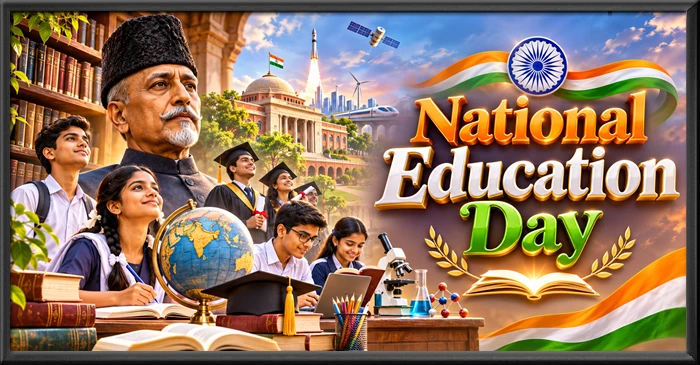
National Education Day is observed annually on November 11 in India.
Established by the Ministry of Human Resource Development in 2008, the observance commemorates the birth anniversary of Maulana Abul Kalam Azad, India's first Education Minister.
First celebrated on November 11, 2008, it promotes educational access, literacy, equality, quality learning, and national development.
National Education Day – History, Founder, Date and Significance in India
National Education Day is observed annually on November 11 in India to commemorate the birth anniversary of Maulana Abul Kalam Azad, the first Education Minister of independent India.
The observance was established by the Government of India's Ministry of Human Resource Development (MHRD) through a resolution dated September 11, 2008. It was first celebrated on November 11, 2008.
National Education Day, also known as Rashtriya Shiksha Diwas, recognises Azad's contributions to education and highlights the importance of literacy, equal educational opportunities, scientific learning, and national development.
History of National Education Day
Establishment of National Education Day – 2008
The Government of India established National Education Day to honour Maulana Abul Kalam Azad's contributions to the country's educational development.
On September 11, 2008, the Ministry of Human Resource Development issued Resolution No. 17-35/2004-PN.I, declaring November 11, Azad's birth anniversary, as National Education Day.
The decision aimed to commemorate his educational philosophy and encourage institutions to promote literacy and quality education.
First National Education Day – November 11, 2008
The first National Education Day was celebrated on November 11, 2008.
President Pratibha Devisingh Patil inaugurated the national celebration at Vigyan Bhavan in New Delhi.
Union Human Resource Development Minister Arjun Singh participated in the ceremony.
The programme recognised Azad's contributions to education, national unity, and social development.
A commemorative postal cover and books about Maulana Azad were released during the inaugural celebration.
Educational institutions across India also organised awareness programmes, seminars, workshops, and activities highlighting the importance of education.
Since then, National Education Day has been observed annually on November 11.
Who Founded National Education Day?
National Education Day was officially established by the Ministry of Human Resource Development, Government of India, in 2008.
The initiative was undertaken during the tenure of Union Human Resource Development Minister Arjun Singh.
Maulana Abul Kalam Azad is the historical personality commemorated by the observance, not its founder.
The occasion honours his role in shaping India's educational system after independence.
Who Was Maulana Abul Kalam Azad?
Maulana Abul Kalam Azad was an Indian independence activist, scholar, journalist, writer, and educationist.
He was born on November 11, 1888, in Mecca, in present-day Saudi Arabia.
His family later settled in Calcutta, now Kolkata, where he pursued his education.
Azad became involved in journalism and India's independence movement, advocating national unity, education, and freedom from British colonial rule.
He served as President of the Indian National Congress and played a prominent role in the freedom struggle.
Following India's independence on August 15, 1947, he became the country's first Union Education Minister.
He continued to serve in the education ministry until his death on February 22, 1958.
Azad believed that education was essential for building an independent, equitable, and progressive society.
He was posthumously awarded India's highest civilian honour, the Bharat Ratna, in 1992.
Maulana Abul Kalam Azad's Contributions to Indian Education
1. Development of India's Education System
As the first Education Minister of independent India, Azad helped lay the foundations for national educational planning.
He advocated expanding educational access and improving the quality of teaching, institutions, and learning opportunities.
2. Universal Primary Education
Azad strongly supported free and compulsory elementary education for children.
He believed that access to education should not depend on a person's social background, economic circumstances, religion, or gender.
His educational philosophy contributed to the development of India's commitment to universal education.
3. Promotion of Higher Education
Azad encouraged the expansion and improvement of universities and higher educational institutions.
He emphasised academic standards, research, professional training, and the development of scientific knowledge.
4. University Grants Commission
Azad played an important role in the development of the University Grants Commission (UGC).
He formally inaugurated the UGC on December 28, 1953.
The commission subsequently became a statutory body under the University Grants Commission Act, 1956.
The UGC was established to coordinate and maintain standards in university education.
5. Development of Technical Education
Azad promoted scientific and technical education as important components of India's development.
The Indian Institute of Technology at Kharagpur was established in 1951 during his tenure as Education Minister.
He also supported the strengthening of technical education institutions and professional training.
6. Cultural and Literary Institutions
Azad recognised the relationship between education and cultural development.
He played a significant role in developing institutions supporting arts, literature, and cultural exchange.
These included the Indian Council for Cultural Relations and national academies associated with music, literature, and fine arts.
His approach connected scientific education with the preservation and development of India's cultural heritage.
Why Is National Education Day Celebrated on November 11?
National Education Day is celebrated on November 11 because the date marks the birth anniversary of Maulana Abul Kalam Azad.
Born on November 11, 1888, Azad became one of the leading figures in India's independence movement and educational development.
The Government of India selected his birthday to acknowledge his contributions and encourage renewed commitment to education.
Unlike annually changing awareness campaigns, the official date of National Education Day remains November 11 every year.
Objectives of National Education Day
The principal objectives of National Education Day are:
- Honour the educational legacy of Maulana Abul Kalam Azad.
- Promote awareness of the importance of education.
- Encourage literacy and lifelong learning.
- Support equal educational opportunities.
- Highlight the importance of quality teaching and learning.
- Encourage scientific thinking, research, and innovation.
- Promote educational inclusion and social development.
- Recognise the contributions of educators and educational institutions.
- Strengthen public commitment to accessible education.
How Is National Education Day Celebrated?
National Education Day is observed through educational and awareness programmes across India.
School and College Programmes
Schools, colleges, and universities organise special assemblies, educational activities, and discussions about the importance of learning.
Seminars and Workshops
Educational institutions conduct seminars and workshops on literacy, teaching methods, educational access, and academic development.
Essay and Speech Competitions
Students participate in essay-writing, elocution, debates, quizzes, and poster-making competitions focusing on education and the legacy of Maulana Azad.
Literacy Awareness Campaigns
Institutions and community organisations conduct awareness activities promoting literacy and the importance of schooling.
Tributes to Maulana Abul Kalam Azad
Educational organisations and public institutions pay tribute to Azad through lectures, commemorative programmes, and discussions about his contributions.
Educational Exhibitions
Some institutions organise book exhibitions, science exhibitions, and displays highlighting educational achievements.
Importance of National Education Day
Educational Equality
National Education Day highlights the importance of making educational opportunities available to people from different social and economic backgrounds.
Literacy and Social Development
Education helps individuals develop knowledge, practical skills, and the ability to participate meaningfully in society.
Scientific and Technical Advancement
Scientific education and research contribute to innovation, technological development, and problem-solving.
Women's Education
Expanding educational opportunities for girls and women supports greater participation in social, economic, and professional life.
National Development
An educated population contributes to economic development, public awareness, democratic participation, and institutional progress.
Recognition of Teachers and Institutions
The observance recognises the work of educational institutions and professionals who support learning and academic development.
National Education Day and Teachers' Day – Difference
National Education Day and Teachers' Day are distinct Indian observances.
| Feature | National Education Day | Teachers' Day |
|---|---|---|
| Date | November 11 | September 5 |
| Commemorates | Maulana Abul Kalam Azad | Dr. Sarvepalli Radhakrishnan |
| Main Focus | Importance and development of education | Contributions of teachers |
| National Education Day Established | 2008 | — |
Both occasions recognise the importance of education but commemorate different historical personalities and emphasise different aspects of the educational system.
Significance of National Education Day
National Education Day recognises Maulana Abul Kalam Azad's vision of education as an essential foundation of national progress.
It encourages reflection on the importance of literacy, inclusive schooling, higher education, scientific research, and educational institutions.
The occasion also connects contemporary discussions about educational opportunities with the historical development of India's post-independence education system.
By commemorating Azad's achievements, National Education Day reinforces the importance of education in strengthening individual opportunity, social equality, and national development.
Conclusion
National Education Day is observed annually on November 11 in India to honour the birth anniversary and educational legacy of Maulana Abul Kalam Azad.
Established by the Ministry of Human Resource Development on September 11, 2008, and first celebrated on November 11, 2008, the observance recognises the contributions of India's first Education Minister.
Its enduring significance lies in promoting literacy, educational equality, quality learning, scientific advancement, and the development of an educated society.
References
- Central Board of Secondary Education – National Education Day Declaration and Government Resolution, 2008 (Referenced in 2020 Circular)
https://cbseacademic.nic.in/web_material/Circulars/2020/85_Circular_2020.pdf - Press Information Bureau – First National Education Day Celebrations, November 11, 2008
https://www.pib.gov.in/newsite/erelcontent.aspx?lang=2®=3&relid=44738 - President of India – Speech at the First National Education Day, November 11, 2008
https://presidentofindia.nic.in/smt-pratibha-devisingh-patil/speeches/speech-president-india-smt-pratibha-devisingh-patil-3 - Ministry of Human Resource Development – Maulana Abul Kalam Azad: Educationist and Scholar Extraordinary (2008)
https://www.pib.gov.in/newsite/erelcontent.aspx?lang=2®=48&relid=44652 - Press Information Bureau – National Education Day: History and Importance
https://www.pib.gov.in/PressReleasePage.aspx?PRID=2072203&lang=1®=1 - University Grants Commission – Genesis and Historical Establishment
https://www.ugc.gov.in/Aboutus/Genesis - Press Information Bureau – Maulana Abul Kalam Azad's Contributions to Indian Education
https://www.pib.gov.in/newsite/erelcontent.aspx?lang=2®=48&relid=54004
Also Read : World Environmental Education Day