

Date
- Date
- 1 Jul 2027
Time
- Time
- ...

Van Mahotsav
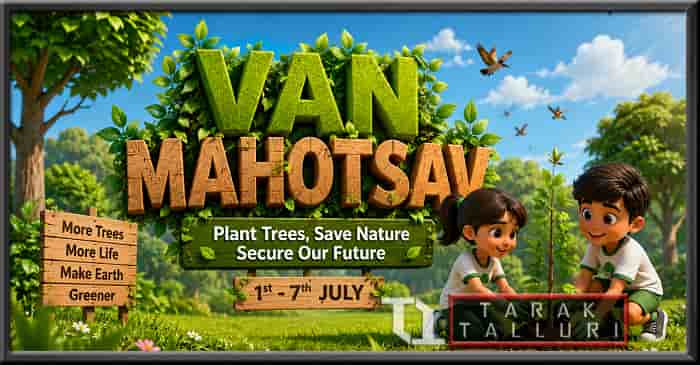
Van Mahotsav is observed annually from July 1 to 7 in India.
The seven-day tree-planting festival was established in 1950 by Union Agriculture and Food Minister K. M. Munshi to promote afforestation and forest conservation.
Its precursor, National Tree Planting Week, was organised by M. S. Randhawa in July 1947.
The festival encourages environmental awareness and public participation.
Van Mahotsav – History, Founder, Dates and Significance
Van Mahotsav, also known as the Festival of Trees or Forest Festival, is observed annually from July 1 to 7 in India. The seven-day celebration promotes tree planting, afforestation, forest conservation, and environmental awareness.
Van-Mahotsav was formally established in 1950 by Kanaiyalal Maneklal Munshi, commonly known as K. M. Munshi, who served as India's Union Minister for Agriculture and Food.
The festival encourages individuals, schools, institutions, communities, and government organisations to participate in tree-planting activities and recognise the importance of forests in maintaining ecological balance.
History of Van Mahotsav
The history of Van Mahotsav dates back to India's early national tree-planting initiatives.
National Tree Planting Week – 1947
The precursor to Van-Mahotsav was the first Indian National Tree Planting Week, organised from July 20 to 27, 1947, under the initiative of M. S. Randhawa, an Indian civil servant, historian, and botanist.
The opening ceremony took place in Delhi on July 20, 1947.
Khurshid Ahmad Khan, the Commissioner of Delhi, inaugurated a morning tree-planting programme involving Bauhinia saplings.
Jawaharlal Nehru, then Vice President of the Interim Government, participated in another ceremony at Purana Qila in Delhi.
The initiative aimed to encourage public involvement in tree planting and promote the protection of natural resources.
Establishment of Van Mahotsav – 1950
In 1950, K. M. Munshi transformed the earlier tree-planting tradition into a nationwide annual programme and introduced the name Van-Mahotsav.
The first Van-Mahotsav began on July 1, 1950.
Munshi shifted the celebration to the first week of July to coincide with the arrival of the monsoon in many parts of India.
The rainy season generally provides favourable conditions for establishing new saplings, particularly where adequate soil moisture supports early growth.
Van-Mahotsav was intended to create widespread enthusiasm for planting trees and preserving forests.
The programme encouraged participation by national leaders, state governments, educational institutions, and the general public.
Who Founded Van Mahotsav?
K. M. Munshi founded Van-Mahotsav in 1950.
An Indian independence activist, lawyer, writer, and political leader, Munshi promoted the celebration during his tenure as Union Minister for Agriculture and Food.
His initiative helped transform tree planting into a nationwide public movement.
Although M. S. Randhawa organised the earlier National Tree Planting Week in 1947, Munshi is recognised as the founder of Van Mahotsav in its established form.
Why Is Van Mahotsav Celebrated from July 1 to 7?
Van Mahotsav is traditionally observed during the first week of July, when the southwest monsoon has arrived in many regions of India.
Rainfall and increased soil moisture can support the survival and establishment of newly planted trees.
The timing also encourages communities to undertake plantation activities before or during favourable seasonal conditions.
However, the timing of local celebrations may vary according to regional monsoon patterns and institutional schedules.
Objectives of Van Mahotsav
The principal objectives of Van Mahotsav include:
- Encouraging large-scale tree planting and afforestation.
- Increasing awareness about forest conservation.
- Preventing soil erosion and protecting soil fertility.
- Promoting the planting and maintenance of trees in villages, farms, and urban areas.
- Providing shade, fruits, fodder, and other useful tree resources.
- Encouraging shelterbelts around agricultural fields.
- Supporting biodiversity and improving environmental conditions.
- Involving communities in the long-term protection of planted trees.
How Is Van Mahotsav Celebrated?
Van Mahotsav is celebrated through tree-planting campaigns and environmental education programmes.
Tree-Planting Drives
Government departments, schools, colleges, and community organisations conduct sapling plantation programmes in public spaces, educational campuses, and other suitable locations.
Environmental Awareness Campaigns
Seminars, exhibitions, documentaries, and awareness activities highlight the importance of forests, biodiversity, and natural resource conservation.
Student Participation
Educational institutions organise plantation drives, environmental competitions, and conservation activities to encourage students to understand their responsibilities towards nature.
Community Involvement
Local communities, environmental organisations, and volunteers participate in planting and maintaining trees.
Promotion of Native Trees
Planting suitable native tree species is encouraged because they are generally better adapted to local ecological conditions and can support regional biodiversity.
Environmental Significance of Van Mahotsav
Forest Conservation
Van Mahotsav encourages the protection and restoration of forests, which provide habitats for numerous plant and animal species.
Climate Regulation
Trees absorb carbon dioxide as they grow and store carbon in their biomass. Protecting forests and establishing appropriate tree cover can contribute to climate-change mitigation.
Soil and Water Conservation
Tree roots help stabilise soil, while vegetation can reduce erosion and support local water-management processes.
Biodiversity Protection
Native trees provide food, shelter, and habitats for birds, insects, and other wildlife.
Public Awareness
The festival connects environmental conservation with public participation, encouraging individuals and institutions to take responsibility for protecting natural resources.
Importance of Tree Maintenance
The success of Van Mahotsav depends not only on planting saplings but also on ensuring their survival.
Newly planted trees require suitable species selection, appropriate planting locations, watering when necessary, protection from damage, and continued maintenance.
Long-term monitoring and care are essential for successful afforestation and ecological restoration.
Van Mahotsav and India's Environmental Heritage
Van Mahotsav reflects India's long-standing cultural association with trees, forests, and nature.
Established during the early years of independent India, the festival helped make tree planting a recognised public activity.
Its continuing observance brings together government agencies, educational institutions, environmental organisations, and local communities.
Conclusion
Van Mahotsav is observed annually from July 1 to 7 in India to promote tree planting, afforestation, and forest conservation.
The festival was formally established in 1950 by K. M. Munshi, building upon the National Tree Planting Week organised by M. S. Randhawa in July 1947.
Van Mahotsav remains an important environmental initiative, encouraging public participation in protecting forests, restoring green cover, and maintaining ecological balance.
References
- Press Information Bureau, Government of India – Van Mahotsav: A Commitment to Green India
https://www.pib.gov.in/PressNoteDetails.aspx?ModuleId=3&NoteId=151913 - Press Information Bureau, Government of India – Van Mahotsav (2008)
https://www.pib.gov.in/newsite/erelcontent.aspx?lang=2®=48&relid=40550 - Nehru Archive – Planting of Trees, 24 July 1953
https://nehruarchive.in/documents/planting-of-trees-24-july-1953-qgyyxn - Press Information Bureau – Environment Minister to Lead Plantation Drive to Celebrate Van Mahotsav
https://www.pib.gov.in/newsite/PrintRelease.aspx?lang=2®=48&relid=167122 - Indian Council of Agricultural Research – Van Mahotsab Celebrated at ICAR-IIPR, Kanpur
https://icar.org.in/node/10327
Also Read : Sonia Gandhi