

Date
- Date
- 28 Nov 2027
Time
- Time
- ...

NCC Day - India
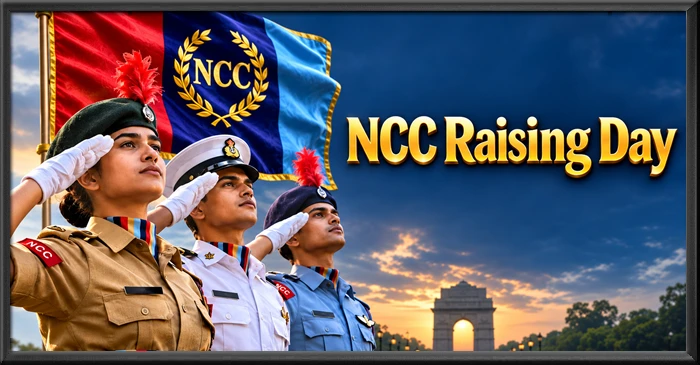
NCC Day or National Cadet Corps Day or NCC Raising Day also known as World NCC Day is observed annually on the fourth Sunday of November in India.
The observance commemorates the formation of the National Cadet Corps on 23 november 1948.
It recognizes the contributions of NCC cadets and promotes unity, discipline, leadership, patriotism, and selfless national service.
NCC Day – History, Origin, Motto, Objectives and Significance
The National Cadet Corps (NCC) is one of India's most important youth development organizations, providing students with opportunities to develop leadership, discipline, character, and a spirit of service. Operating under the Ministry of Defence, it offers structured training through its Army, Navy, and Air Force wings.
NCC Day celebrates the organization's historical legacy and recognizes generations of cadets who have contributed to community development, national integration, and public service.
History and Origin of NCC Day
The origins of the National Cadet Corps can be traced to the University Corps, established in British India in 1917 to provide military-related training to university students.
In 1920, the University Corps was reorganized as the University Training Corps. It was subsequently renamed the University Officers Training Corps in 1942.
Following the Second World War, Indian leaders recognized the need for a national youth organization that would develop character, leadership, discipline, and a sense of responsibility among students.
In 1946, a committee headed by Pandit H. N. Kunzru was established to examine the creation of a nationwide cadet organization.
Its recommendations contributed to the enactment of the National Cadet Corps Act, 1948 (Act No. 31 of 1948), which received assent on 16 April 1948.
The modern NCC was inaugurated in July 1948 under the Ministry of Defence.
Why Is NCC Day Celebrated on the Fourth Sunday of November?
NCC Day is traditionally observed on the fourth Sunday of November to commemorate an important event in the organization's early history.
In November 1948, India's first Prime Minister, Jawaharlal Nehru, presided over a ceremony marking the raising of the first NCC unit in Delhi.
The ceremony took place on the last Sunday of November 1948, establishing the historical association between the month and the organization's annual celebrations.
The fourth Sunday of November subsequently became the established date for NCC Day.
Unlike fixed-date national observances, NCC Day changes its calendar date each year.
Establishment and Development of the National Cadet Corps
The National Cadet Corps was established to provide organized training to young people and develop responsible citizens capable of contributing to national development.
Its initial structure primarily focused on military-style training, physical fitness, character development, and leadership.
In 1949, the Girls Division was introduced, extending participation opportunities to female students.
Over subsequent decades, the NCC expanded across schools and colleges throughout India.
The organization also developed programmes involving social service, environmental protection, disaster preparedness, adventure training, and national integration.
Today, the NCC functions as a tri-service youth organization, drawing its training traditions from the Indian Army, Indian Navy, and Indian Air Force.
Motto of the National Cadet Corps
The official motto of the NCC is "Unity and Discipline" (Ekta Aur Anushasan).
The motto was formally selected during the 12th meeting of the NCC Central Advisory Committee on 12 October 1980.
Unity represents national integration, mutual respect, and cooperation among people from different regions, languages, religions, and cultural backgrounds.
Discipline emphasizes personal responsibility, punctuality, self-control, teamwork, and dedication to duty.
Together, these principles form the foundation of NCC training and its broader approach to youth development.
Objectives of NCC Day
NCC Day highlights the organization's mission and encourages young people to develop qualities that contribute to personal growth and national development.
Its principal objectives include:
- Promoting unity, discipline, patriotism, and responsible citizenship.
- Recognizing the service and achievements of NCC cadets.
- Encouraging leadership, teamwork, and character development.
- Supporting national integration and cultural understanding.
- Promoting community welfare and voluntary social service.
- Encouraging physical fitness, adventure, and self-confidence.
- Inspiring young people to consider careers in the Indian Armed Forces.
These objectives reflect the NCC's educational and service-oriented role in Indian society.
Importance and Significance of NCC Day
NCC Day recognizes the contributions of young people who participate in disciplined training and community-oriented activities.
Cadets develop organizational skills, physical endurance, confidence, and an understanding of their responsibilities toward society.
The organization brings together students from diverse social, cultural, and regional backgrounds, encouraging cooperation and mutual respect.
Its activities also help participants develop leadership qualities that may benefit them in education, employment, public service, and other professional fields.
The observance reinforces the importance of responsible citizenship and voluntary participation in nation-building activities.
Role of NCC Cadets in National Service
NCC cadets have participated in several forms of public service throughout the organization's history.
During the India–Pakistan conflicts of 1965 and 1971, cadets assisted civil defence authorities and supported activities such as traffic management, rescue operations, and other wartime services.
In subsequent decades, the NCC expanded its focus on community development and social welfare.
Cadets participate in activities such as blood donation, cleanliness campaigns, tree plantation drives, environmental awareness programmes, and disaster preparedness initiatives.
These activities demonstrate the organization's emphasis on applying discipline and leadership skills in practical service to society.
How Is NCC Day Celebrated in India?
NCC Day is celebrated by NCC directorates, battalions, educational institutions, and cadet units across India.
Activities commonly include:
- Ceremonial parades and march-pasts.
- Tributes to members of the Indian Armed Forces.
- Blood donation and health awareness camps.
- Tree plantation and environmental campaigns.
- Community cleanliness and public welfare initiatives.
- Cultural programmes and national integration activities.
- Recognition of outstanding cadets and NCC personnel.
- Adventure, leadership, and personality development programmes.
Commemorative events may also take place at the National War Memorial in New Delhi, where senior defence officials and NCC representatives pay tribute to fallen service personnel.
NCC Day and Youth Development
The National Cadet Corps has become an important institution for developing leadership and service-oriented attitudes among Indian students.
Its training programmes encourage young people to work cooperatively, respect differences, and demonstrate resilience when facing challenges.
The experience can also help cadets build confidence in public speaking, decision-making, teamwork, and organizational responsibilities.
The observance highlights the continuing relevance of these qualities in education, community life, and national development.
Frequently Asked Questions
When is NCC Day celebrated in India?
NCC Day is celebrated annually on the fourth Sunday of November.
When is NCC Day in 2026?
NCC Day falls on Sunday, 22 November 2026.
When was the National Cadet Corps established?
The National Cadet Corps was established in 1948 under the National Cadet Corps Act, 1948.
Why is NCC Day observed in November?
It commemorates the raising of the first NCC unit in Delhi, an event attended by Prime Minister Jawaharlal Nehru in November 1948.
What is the full form of NCC?
NCC stands for National Cadet Corps.
What is the motto of NCC?
The official motto is "Unity and Discipline."
Who was the first Director of NCC?
Colonel Gopal Gurunath Bewoor was the first Director of the National Cadet Corps.
Which ministry administers the NCC?
The National Cadet Corps operates under India's Ministry of Defence.
Is NCC Day observed worldwide?
No. NCC Day is a national observance in India, associated with the Indian National Cadet Corps.
Conclusion
NCC Day represents the longstanding contribution of the National Cadet Corps to youth development, national integration, and public service in India.
The observance recognizes the dedication of cadets and reinforces the enduring importance of leadership, discipline, teamwork, and responsible citizenship.
Through its educational programmes and community initiatives, the NCC continues to play an important role in preparing young people for service and leadership.
References
- Press Information Bureau, Government of India – NCC Raising Day Celebrations and History (2025)
- Press Information Bureau – Prime Minister's Mann Ki Baat, NCC Day Observed on the Fourth Sunday of November
- Government of India – Historical Origin of NCC Day and Its Motto
- NCC Directorate, Government of Delhi – Genesis of the National Cadet Corps
- NCC Directorate, Government of Uttarakhand – Objectives of NCC
- India Code, Government of India – National Cadet Corps Act, 1948
Also Read : Kasturi Ranga Iyengar