

Date
- Date
- 13 Jul 2027
Time
- Time
- ...
Non-Binary Awareness Week
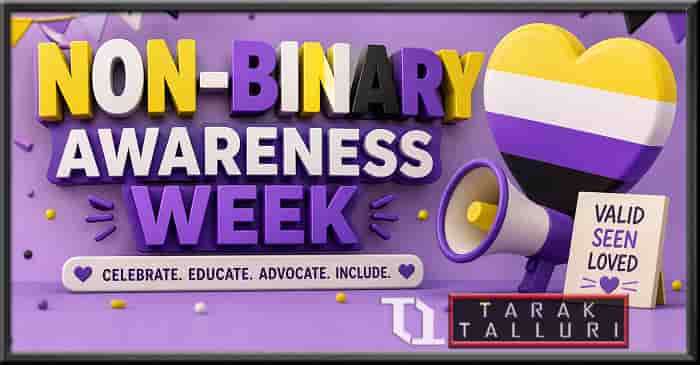
Non-Binary Awareness Week is observed annually during the week containing 14 July, International Non-Binary People's Day.
Growing from the awareness day proposed by Katje van Loon in 2012, the week celebrates people whose gender identities extend beyond the male–female binary.
It promotes visibility, understanding, inclusion, and respect while highlighting discrimination and barriers faced by non-binary communities.
Non-Binary Awareness Week
Non-Binary Awareness Week is an annual LGBTQ+ awareness observance held in July during the week containing International Non-Binary People's Day on 14 July. The week celebrates non-binary people, highlights their experiences and contributions, and encourages greater understanding of gender diversity.
Through educational activities, community events, and awareness campaigns, the observance promotes visibility, equality, inclusion, and respect for people whose gender identities fall outside the traditional categories of exclusively male or female.
History and Origin of Non-Binary Awareness Week
The history of Non-Binary Awareness Week is closely connected to International Non-Binary People's Day, which was proposed in 2012 by Canadian writer and activist Katje van Loon.
Van Loon proposed creating a dedicated day to recognise people whose gender identities do not fit exclusively within the traditional male–female binary.
The date 14 July was chosen because it falls halfway between International Women's Day on 8 March and International Men's Day on 19 November.
As recognition of International Non-Binary People's Day grew, community organisations and LGBTQ+ advocates began promoting a wider awareness period surrounding the date.
Non-Binary Awareness Week was publicly recognised by 2020, providing a longer opportunity for educational programmes, community discussions, and advocacy.
The week does not have a clearly verified single founder or universally recognised founding date separate from International Non-Binary People's Day.
When Is Non-Binary Awareness Week Observed?
Non-Binary Awareness Week is observed annually in July during the week containing 14 July.
Many organisations use the Monday–Sunday week containing International Non-Binary People's Day. However, some community calendars use different weekly boundaries, so published dates may vary between organisations.
Non-Binary Awareness Week Dates
| Year | Monday–Sunday observance |
|---|---|
| 2024 | 8–14 July |
| 2025 | 14–20 July |
| 2026 | 13–19 July |
| 2027 | 12–18 July |
These dates follow the Monday–Sunday calendar convention. They should not be interpreted as a globally mandated schedule.
What Does Non-Binary Mean?
Non-binary is an umbrella term describing people whose gender identity does not fit exclusively within the categories of man or woman.
Non-binary identities and experiences are diverse.
Some individuals may identify with aspects of both genders, while others may identify with neither, experience their gender as fluid, or understand their identity outside conventional gender categories.
Terms associated with the broader non-binary spectrum include:
- Genderfluid: A gender identity that may change over time.
- Agender: An identity associated with having no gender or identifying as genderless.
- Bigender: An identity involving two genders.
- Genderqueer: A broad term describing identities outside conventional gender expectations.
Not every non-binary person uses these terms, and individuals should be described using the identities and language they choose for themselves.
Gender identity and sexual orientation are different concepts. Being non-binary does not determine a person's sexual or romantic orientation.
Objectives and Significance
The primary purpose of Non-Binary Awareness Week is to promote recognition, dignity, and equal treatment for non-binary people.
Its major objectives include:
- Increasing public understanding of non-binary identities.
- Raising awareness of discrimination and social exclusion.
- Encouraging respectful and inclusive communication.
- Supporting non-binary visibility in education, employment, healthcare, and public life.
- Promoting equal opportunities and access to services.
- Recognising the achievements and contributions of non-binary individuals.
- Encouraging constructive conversations about gender diversity.
The observance also highlights the importance of listening to people with lived experiences rather than relying on stereotypes or assumptions.
Non-Binary Pride Flag: History and Meaning
The Non-Binary Pride Flag was created in 2014 by Kye Rowan to represent people whose gender identities exist beyond the traditional binary.
The flag consists of four horizontal stripes:
- Yellow: Represents gender identities outside the binary.
- White: Represents people with multiple or all genders.
- Purple: Represents gender identities involving a combination of or experience between male and female.
- Black: Represents people who identify as agender or without gender.
The flag has become an internationally recognised symbol of non-binary identity, visibility, and community.
How Is Non-Binary Awareness Week Observed?
Non-Binary Awareness Week is marked through various community, educational, and advocacy activities.
Common observances include:
Educational Programmes
Schools, universities, and organisations may conduct discussions, workshops, and awareness sessions about gender diversity.
Social Media Campaigns
Individuals and advocacy organisations share educational resources, personal experiences, and messages supporting non-binary inclusion.
Community Events
LGBTQ+ organisations may arrange gatherings, panel discussions, and cultural activities that highlight non-binary experiences and achievements.
Workplace Inclusion Initiatives
Employers may review inclusive policies, improve workplace language, and provide training on respectful communication.
Recognition and Visibility
Communities may display the non-binary pride flag, promote non-binary creators and professionals, and support initiatives addressing discrimination.
Non-Binary Awareness Week and International Non-Binary People's Day
Although related, these observances are distinct.
International Non-Binary People's Day is observed annually on 14 July. It originated in 2012 following a proposal by Katje van Loon.
Non-Binary Awareness Week is the broader awareness period surrounding that date.
The week provides additional opportunities for education, advocacy, community engagement, and conversations about the rights and experiences of non-binary people.
Both observances promote greater understanding of gender diversity, but their historical beginnings should not be treated as identical.
How Can People Support Non-Binary Inclusion?
Support for non-binary people involves recognising their dignity, identities, and individual experiences.
Practical steps include:
- Respecting people's names and pronouns.
- Avoiding assumptions about gender based on appearance.
- Using inclusive language in public communication.
- Supporting equal access to education, employment, and healthcare.
- Addressing discrimination and harassment.
- Listening to non-binary perspectives and experiences.
- Encouraging respectful and inclusive institutional policies.
Meaningful inclusion extends beyond awareness activities and requires consistent respect in everyday interactions.
Frequently Asked Questions
When is Non-Binary Awareness Week observed?
It is observed annually during the week containing 14 July, which is International Non-Binary People's Day.
When did Non-Binary Awareness Week begin?
The week developed around International Non-Binary People's Day, established in 2012. The broader week-long observance was publicly recognised by 2020, although a universally established founding date for the week has not been verified.
Who founded Non-Binary Awareness Week?
No single founder has been conclusively established for the week itself. Katje van Loon proposed International Non-Binary People's Day in 2012.
When is Non-Binary Awareness Week in 2026?
Using the Monday–Sunday convention, it takes place from 13 to 19 July 2026.
What is the purpose of Non-Binary Awareness Week?
The observance raises awareness of non-binary identities, celebrates gender diversity, and encourages inclusion, equality, and respect.
What are the colours of the Non-Binary Pride Flag?
The flag features yellow, white, purple, and black horizontal stripes.
Is Non-Binary Awareness Week the same as Pride Month?
No. Pride Month is generally observed in June and celebrates the broader LGBTQ+ community. Non-Binary Awareness Week is a separate July awareness observance focusing specifically on non-binary people.
Conclusion
Non-Binary Awareness Week is an annual July observance dedicated to increasing visibility, understanding, and respect for non-binary people.
Developing around International Non-Binary People's Day, established in 2012, the week has become an opportunity for communities and organisations to celebrate gender diversity, address discrimination, and promote meaningful inclusion.
References
- Lancashire LGBT — Non-Binary Awareness Week
https://lancslgbt.org.uk/non-binary-awareness-week/ - TU Dortmund University — International Non-Binary Day: History and Background
https://gleichstellung.tu-dortmund.de/en/projects/up-to-date/all-days/international-non-binary-day/ - University College London — International Non-Binary People's Day
https://www.ucl.ac.uk/news/2024/jul/14-july-marks-international-non-binary-peoples-day - Queen Mary University of London — LGBTQIA+ Calendar 2026
https://www.qmul.ac.uk/pride-month/support-resources-volunteering/lgbtqia-calendar-2026/ - Stonewall — LGBTQ+ Terms and Definitions
https://www.stonewall.org.uk/resources/list-lgbtq-terms - Human Rights Campaign — LGBTQ+ Pride Flags
https://www.hrc.org/resources/lgbtq-pride-flags - GLAAD — LGBTQ Community Calendar
https://glaad.org/reference/calendar/
Alro Read: International Stress Awareness Week