

Date
- Date
- 27 Nov 2026
Time
- Time
- ...
International Day of Engagement in Science for Sustainable Development
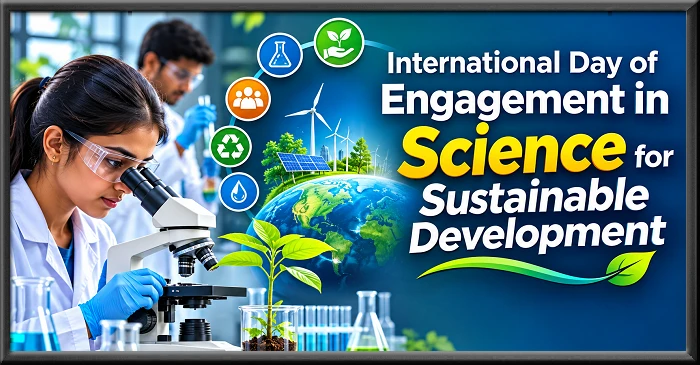
International Day of Engagement in Science for Sustainable Development is observed annually on November 27.
It was proclaimed by UNESCO on November 8, 2025, following an initiative by Ukraine.
The observance promotes public participation in science, citizen science, scientific literacy, and inclusive access to scientific knowledge to address global challenges and advance sustainable development for present and future generations worldwide.
History of International Day of Engagement in Science for Sustainable Development
The initiative to establish this international observance was led by Ukraine, with Professor Stanislav Dovgyi, President of the Junior Academy of Sciences of Ukraine, playing a prominent role in its development.
On April 14, 2025, the UNESCO Executive Board supported the proposal during its 221st session.
The initiative received support from numerous countries, including India, France, Germany, Japan, Poland, South Africa, and Spain.
On November 8, 2025, the 43rd session of the UNESCO General Conference, held in Samarkand, Uzbekistan, adopted the resolution establishing the international observance.
The inaugural celebration is scheduled for November 27, 2026.
Why November 27 Was Chosen
November 27 holds particular historical significance for the Ukrainian scientific community.
According to the Junior Academy of Sciences of Ukraine, the date commemorates two important milestones:
- The birth of Borys Paton, a distinguished Ukrainian scientist and welding technology researcher.
- The establishment of the Ukrainian Academy of Sciences, now known as the National Academy of Sciences of Ukraine.
The selection of this date connects Ukraine's scientific heritage with international efforts to advance research, innovation, and public engagement in science.
Official Objectives
UNESCO identifies four principal objectives of the observance:
- Recognizing scientific knowledge as a shared resource that benefits humanity and the environment.
- Expanding opportunities for people from diverse backgrounds to participate in scientific activities.
- Improving communication and cooperation among researchers, policymakers, and the public.
- Strengthening scientific education and developing skills, particularly among young people.
International Decade of Sciences for Sustainable Development (2024–2033)
The observance supports the International Decade of Sciences for Sustainable Development, proclaimed by the United Nations General Assembly on August 25, 2023, through Resolution A/RES/77/326.
UNESCO was entrusted with leading its implementation.
The initiative was officially launched on December 2, 2024, to mobilize scientific expertise across basic, applied, social, and human sciences in support of sustainable development.
It encourages international scientific collaboration, interdisciplinary research, knowledge accessibility, and the application of scientific discoveries to societal and environmental challenges.
Role of Science in Achieving Sustainable Development Goals
Scientific research and technological innovation contribute to the achievement of the 17 United Nations Sustainable Development Goals (SDGs).
Important areas of contribution include:
- Developing sustainable agricultural practices and improving food security.
- Advancing medical research and public healthcare.
- Improving access to clean water and sanitation.
- Developing renewable energy technologies.
- Addressing climate change and environmental degradation.
- Protecting biodiversity and natural ecosystems.
- Building sustainable infrastructure and resilient communities.
Scientific evidence also enables governments and institutions to formulate informed policies and evaluate development programmes.
Importance of Citizen Science
Citizen science enables members of the public to participate in scientific research through observation, data collection, analysis, and collaborative investigation.
Examples include monitoring biodiversity, recording weather conditions, measuring environmental pollution, and participating in community-based conservation projects.
Such initiatives expand research capabilities while helping communities develop scientific understanding and contribute to decisions affecting their lives.
Open Science and Scientific Accessibility
Open science promotes the accessibility of research findings, scientific data, educational resources, and collaborative research opportunities.
Reducing barriers to scientific knowledge can strengthen cooperation between researchers, institutions, and communities across geographical and socioeconomic boundaries.
It also creates opportunities for developing countries and underrepresented communities to participate more actively in scientific advancement.
First Celebration – 2026
UNESCO has announced two major components for the inaugural celebration:
- An international webinar bringing together researchers, policymakers, young scientists, and civil society representatives.
- Community-based scientific activities organized worldwide through a global call for participation.
The inaugural programme focuses on youth involvement, grassroots scientific initiatives, and policies that support wider participation in science.
Significance of International Day of Engagement in Science for Sustainable Development
Scientific discoveries achieve greater societal value when people can understand, access, and apply them.
The observance encourages stronger relationships between scientific institutions and communities, promotes evidence-based decision-making, and supports the responsible application of emerging technologies.
It also highlights the importance of scientific cooperation in overcoming inequalities in education, research opportunities, technological development, and access to knowledge.
How the Day Is Observed
Educational institutions, research organizations, governments, science museums, and communities can participate through:
- Science exhibitions and festivals.
- Public lectures and scientific demonstrations.
- Research workshops and educational programmes.
- Citizen science and community research projects.
- Open laboratory visits.
- Discussions on sustainable technologies and environmental conservation.
These activities provide opportunities for people of different ages and backgrounds to engage directly with scientific knowledge and research.
Difference Between World Science Day for Peace and Development and International Day of Engagement in Science for Sustainable Development
World Science Day for Peace and Development is observed on November 10 and emphasizes the relationship between science, society, peace, and development.
International Day of Engagement in Science for Sustainable Development is observed on November 27 and places particular emphasis on active public participation, citizen science, scientific accessibility, and achieving sustainable development.
Both are UNESCO-proclaimed international observances with complementary objectives.
References
- UNESCO – International Day of Engagement in Science for Sustainable Development
- UNESCO – First International Day of Engagement in Science for Sustainable Development
- Ministry of Foreign Affairs of Ukraine – UNESCO Approves Ukraine's Initiative
- Junior Academy of Sciences of Ukraine – History and Establishment of the International Day
- UNESCO – International Decade of Sciences for Sustainable Development (2024–2033)
- UNESCO – 43rd Session of the General Conference
Also Read : World Science Day for Peace and Development