

Date
- Date
- 24 Nov 2026
Time
- Time
- ...

Evolution Day
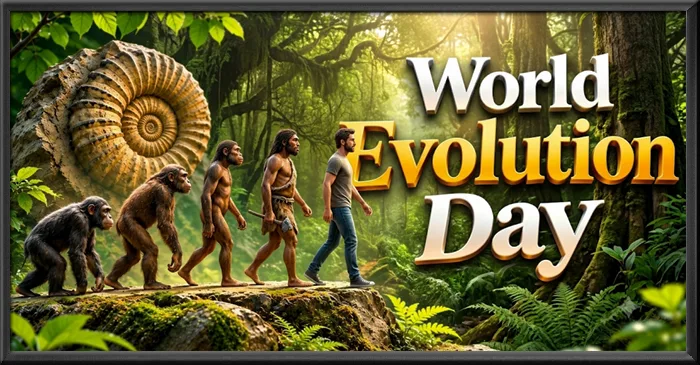
Evolution Day also called World Evolution Day, is observed annually on 24 November.
The observance commemorates the publication of Charles Darwin's On the Origin of Species in 1859, which explained evolution through natural selection.
It promotes scientific literacy, understanding of biodiversity and common ancestry, and recognition of the contributions of Darwin and Alfred Russel Wallace to evolutionary biology.
Evolution Day – History, Origin, Charles Darwin, Objectives and Significance
The publication of Charles Darwin's On the Origin of Species transformed scientific understanding of the diversity of life on Earth. By presenting extensive evidence that species change over generations through natural processes, the book challenged established explanations of biological diversity and helped establish the foundations of modern evolutionary biology.
Evolution Day recognizes this major achievement in the history of science. The observance also encourages public understanding of natural selection, common ancestry, adaptation, biodiversity and the continuing development of evolutionary research.
History and Origin of Evolution Day
The history behind Evolution Day is closely connected with British naturalist Charles Darwin (1809–1882) and his scientific investigations into the origin and diversity of species.
During the nineteenth century, many naturalists classified living organisms as fixed and separately created forms. However, geological discoveries, fossils and observations of living organisms increasingly raised questions about whether species could change over long periods.
Darwin investigated these questions through scientific observation, comparative research and experiments.
His work eventually produced an explanation of evolutionary change through natural selection.
Evolution Day commemorates the anniversary of his landmark book's publication. Although observed informally by science enthusiasts and educational communities, the exact founder and establishment year of the annual observance have not been reliably documented.
Charles Darwin and the Voyage of HMS Beagle
Darwin's scientific development was strongly influenced by his voyage aboard the British survey ship HMS Beagle.
Between 1831 and 1836, he travelled through South America, the Galápagos Islands and other regions, studying geological formations, fossils, plants and animals.
During the expedition, he collected specimens and documented variations among organisms living in different environments.
His observations of mockingbirds, tortoises and other animals in the Galápagos Islands contributed to his later thinking about species distribution and evolutionary relationships.
Following his return to England, Darwin continued examining his collections and studying artificial selection, domestication and the geographical distribution of species.
These investigations helped him develop the principle of natural selection.
Charles Darwin and Alfred Russel Wallace
Charles Darwin was not the only scientist to develop an explanation of evolution through natural selection.
British naturalist Alfred Russel Wallace (1823–1913) independently developed a similar theory while studying organisms in Southeast Asia.
In 1858, Wallace sent Darwin an essay describing his ideas about natural selection.
Recognizing the similarity between their conclusions, scientists Charles Lyell and Joseph Dalton Hooker arranged for their work to be presented together.
On 1 July 1858, papers by Darwin and Wallace were presented at the Linnean Society of London.
This event marked the first joint scientific announcement of their theories of evolution through natural selection.
Both scientists are therefore recognized for their contributions to the development of evolutionary theory.
Publication of On the Origin of Species in 1859
Charles Darwin's book, On the Origin of Species by Means of Natural Selection, was published in London by John Murray on 24 November 1859.
The publication provided a detailed scientific argument explaining how species can undergo gradual changes over generations.
Darwin drew upon evidence from domesticated animals, geographical distribution, fossils, biological variation and relationships among different organisms.
He proposed that species share common ancestors and that natural selection is an important mechanism through which evolutionary changes occur.
The first edition attracted considerable attention and sold out through the book trade soon after its release.
Its publication became one of the defining milestones in the history of biological science.
What Is Evolution?
Biological evolution refers to changes in the inherited characteristics of populations across successive generations.
Over long periods, these changes can contribute to adaptation, diversification and the formation of new species.
Modern evolutionary biology explains evolution through several mechanisms, including:
- Natural selection.
- Genetic mutation.
- Genetic drift.
- Gene flow.
- Sexual selection.
Evolution does not mean that individual organisms deliberately change their inherited characteristics in response to their needs.
Instead, evolutionary changes occur across populations and generations.
What Is Natural Selection?
Natural selection is a process through which inherited characteristics affecting survival or reproduction can become more or less common within a population.
The process involves three important conditions:
- Variation: Individuals within a population differ in their characteristics.
- Inheritance: Some of these differences can be passed from parents to offspring.
- Differential Reproduction: Certain inherited characteristics can improve reproductive success under particular environmental conditions.
Over successive generations, advantageous inherited characteristics may become more common.
Natural selection is one of the major mechanisms of evolution, although it is not the only process responsible for evolutionary change.
Scientific Evidence Supporting Evolution
Since Darwin's time, scientific discoveries have greatly expanded the evidence supporting evolutionary biology.
Fossil Records
Fossils provide evidence of organisms that lived in the past and document changes in life forms across geological periods.
Comparative Anatomy
Similar anatomical structures among different organisms can indicate shared evolutionary ancestry.
Genetics and DNA
Genetic similarities reveal evolutionary relationships among species and provide evidence of common descent.
Biogeography
The geographical distribution of plants and animals helps explain how organisms diversified and adapted to different environments.
Direct Observations
Evolutionary changes can be observed in living populations, including changes in microbial resistance to antimicrobial medicines.
Together, these independent lines of evidence provide strong scientific support for evolution.
Objectives of Evolution Day
The main objectives of Evolution Day include:
- Commemorating the publication of Darwin's On the Origin of Species.
- Recognizing the scientific contributions of Charles Darwin and Alfred Russel Wallace.
- Promoting public understanding of evolutionary biology.
- Encouraging scientific literacy and evidence-based learning.
- Raising awareness of biodiversity and common ancestry.
- Supporting education in genetics, ecology and natural history.
- Encouraging critical thinking and scientific inquiry.
- Highlighting the continuing importance of evolutionary research.
The observance promotes understanding of evolution as a fundamental principle of modern biological science.
Importance and Significance of Evolution Day
Evolution Day highlights one of the most influential developments in the history of science.
Darwin's work provided a framework for understanding the relationships among organisms and the processes contributing to biological diversity.
The theory of evolution subsequently became central to genetics, ecology, microbiology, conservation biology and several other scientific disciplines.
Modern research uses evolutionary principles to investigate topics such as antimicrobial resistance, the emergence of infectious diseases, species adaptation and biodiversity conservation.
The observance also encourages the public to understand how scientific explanations develop through observation, evidence, testing and revision.
Evolution Day and Darwin Day
Evolution Day and Darwin Day are related commemorations, but they recognize different historical milestones.
Evolution Day is observed on 24 November, marking the publication of On the Origin of Species in 1859.
Darwin Day is celebrated on 12 February, commemorating Charles Darwin's birth in 1809.
Darwin Day focuses broadly on Darwin's scientific legacy, while Evolution Day emphasizes the publication that transformed the study of evolutionary biology.
Both observances encourage scientific literacy and the public appreciation of evolutionary science.
They are separate commemorations rather than parts of a single officially established international celebration.
How Is Evolution Day Observed?
Evolution Day may be marked by educational institutions, museums, scientists, teachers and science enthusiasts through activities such as:
- Public lectures about evolutionary biology.
- Discussions of Darwin's writings.
- Educational exhibitions featuring fossils and natural history collections.
- Workshops on genetics, adaptation and biodiversity.
- Classroom discussions about natural selection.
- Science documentaries and educational presentations.
- Visits to natural history museums.
- Public science communication activities.
Because Evolution Day is an informal observance, activities vary among participating institutions and communities.
Evolution Day and Modern Biological Science
Evolutionary biology has advanced considerably since the publication of Darwin's original work.
The development of genetics during the twentieth century helped explain how inherited characteristics pass between generations.
Subsequent advances in molecular biology and DNA sequencing made it possible to compare the genetic relationships of organisms in greater detail.
Modern evolutionary research combines genetics, paleontology, ecology, developmental biology and computational methods.
These developments have expanded scientific understanding while preserving natural selection and common ancestry as central principles of evolutionary theory.
Frequently Asked Questions
When is Evolution Day observed?
Evolution Day is observed annually on 24 November.
Why is Evolution Day celebrated on 24 November?
The date commemorates the publication of Charles Darwin's On the Origin of Species on 24 November 1859.
Who founded Evolution Day?
No reliably established individual or organization has been identified as the founder of the observance.
Who wrote On the Origin of Species?
British naturalist Charles Darwin wrote On the Origin of Species.
When was On the Origin of Species first published?
The book was first published on 24 November 1859 in London by John Murray.
Did Charles Darwin discover evolution alone?
No. Evolutionary ideas existed before Darwin, and Alfred Russel Wallace independently developed the theory of natural selection. Their contributions were jointly presented in 1858.
What is the difference between Evolution Day and Darwin Day?
Evolution Day marks the publication of On the Origin of Species on 24 November, while Darwin Day commemorates Darwin's birthday on 12 February.
Is Evolution Day officially recognized by the United Nations?
No verified United Nations proclamation establishes Evolution Day as an official international observance.
Why is evolution important to modern science?
Evolution explains changes in populations over generations and provides a scientific framework for understanding biodiversity, biological adaptation and common ancestry.
Conclusion
Evolution Day commemorates the publication of one of the most influential scientific books in history.
Darwin's explanation of evolution through natural selection, alongside Wallace's independent contributions, transformed the study of biological diversity and established important foundations for modern evolutionary science.
The observance encourages scientific literacy, appreciation of biodiversity and recognition of the continuing role of evolutionary research in understanding life on Earth.
References
- Darwin Online – On the Origin of Species, First Edition (1859)
- The Linnean Society – Charles Darwin and Alfred Russel Wallace's Presentation of Natural Selection in 1858
- Natural History Museum, London – What Is Natural Selection?
- Smithsonian Institution – Evolution and the Evidence for Human Origins
- The Linnean Society – Darwin Day and the Historical Publication of On the Origin of Species
Also Read : International Meatless Day