

Date
- Date
- 23 Nov 2026
Time
- Time
- ...
World Watercolor Day
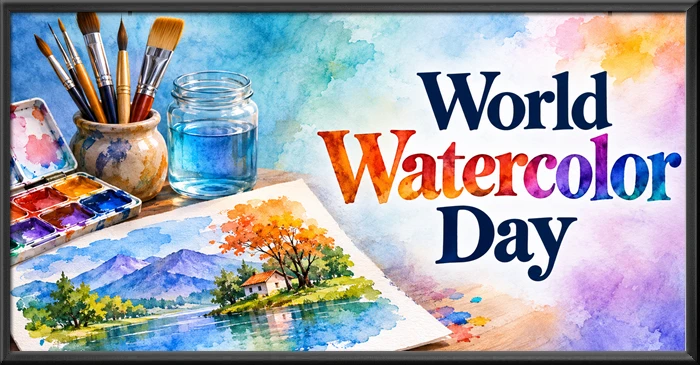
World Watercolor Day is observed annually on 23 November.
Initiated by Mexican artist Alfredo Guati Rojo, the observance promotes watercolor painting as an independent art form.
It celebrates artistic creativity, encourages exhibitions and workshops, and recognizes the contributions of watercolor artists worldwide.
The initiative developed through international cooperation among watercolor societies and artistic communities.
World Watercolor Day – History, Origin, Founder, Objectives and Significance
World Watercolor Day highlights a painting tradition admired for its transparency, fluidity, and expressive use of colour. From delicate landscapes and botanical illustrations to portraits and abstract compositions, watercolor has developed into a versatile medium in the visual arts.
The observance reflects efforts by artists and cultural organizations to establish watercolor painting as a significant artistic discipline and strengthen cooperation among painters internationally.
History and Origin of World Watercolor Day
The origins of World Watercolor Day are closely associated with Mexican painter Alfredo Guati Rojo (1918–2003), who devoted much of his professional life to promoting watercolor as an independent form of fine art.
During the twentieth century, watercolor was sometimes treated primarily as a medium for preliminary sketches and studies rather than finished artistic works.
Guati Rojo challenged this perception by organizing exhibitions, supporting artists, and developing institutions dedicated to watercolor painting.
His advocacy eventually extended beyond Mexico, encouraging cooperation among watercolor societies in different countries.
Establishment of World Watercolor Day
Historical sources provide different dates concerning the establishment of the observance.
A document issued by Mexico's National Watercolor Museum states that World Watercolor Day was instituted by Alfredo Guati Rojo on 23 November 1994.
However, a 2006 report in the Mexican newspaper La Jornada, based on information from the museum's director, identifies 2001 as the year from which 23 November was observed internationally.
Spanish watercolor associations have also associated the international celebration with 2001.
These records confirm Guati Rojo's founding role and the annual date, although they differ on the chronology of its establishment and wider international adoption.
Who Was Alfredo Guati Rojo?
Alfredo Guati Rojo was a Mexican painter, educator, and cultural promoter born on 1 December 1918 in Cuernavaca, Morelos, Mexico.
He studied fine arts at the Academy of San Carlos and developed a particular interest in watercolor painting.
Recognizing the need for greater institutional support for watercolor artists, he helped establish organizations and exhibitions devoted to the medium.
His most significant initiatives included:
- 1964: Founded the Mexican Society of Watercolor Artists.
- 1967: Established the National Watercolor Museum in Mexico City.
- 1994: Established the International Watercolor Biennial.
- World Watercolor Day: Initiated the international observance celebrated on 23 November.
His contributions helped strengthen watercolor painting's institutional recognition in Mexico and encouraged international artistic collaboration.
Why Is World Watercolor Day Celebrated on 23 November?
World Watercolor Day is celebrated on 23 November because Alfredo Guati Rojo designated the date for an international celebration of watercolor painting.
The observance was intended to encourage recognition of watercolor as a complete artistic medium rather than merely a preparatory technique.
The date became associated with exhibitions, demonstrations, public painting activities, and international cooperation among watercolor societies.
It is an artist-led cultural observance rather than a day formally proclaimed by the United Nations.
What Is Watercolor Painting?
Watercolor is a painting technique that uses pigments dispersed in water, generally with gum arabic as a binding agent.
The paint is commonly applied to paper, where transparent layers allow light to reflect from the surface beneath the pigments.
This characteristic creates the luminous appearance associated with traditional watercolor paintings.
Watercolor artists employ techniques such as wet-on-wet painting, wet-on-dry application, transparent washes, glazing, and dry-brush work.
The medium is particularly valued for its ability to represent atmospheric effects, natural landscapes, light, movement, and subtle colour transitions.
Watercolor painting has been used in artistic traditions, botanical illustration, architectural studies, travel documentation, and scientific illustration.
Objectives of World Watercolor Day
The main objectives of the observance include:
- Promoting watercolor painting as an independent fine-art medium.
- Recognizing the contributions of watercolor artists.
- Encouraging artistic creativity and experimentation.
- Supporting exhibitions, workshops, and educational programmes.
- Preserving traditional watercolor techniques.
- Encouraging young and emerging artists.
- Strengthening international cooperation among watercolor associations.
- Promoting public appreciation of watercolor art.
These objectives reflect Alfredo Guati Rojo's efforts to increase the recognition and accessibility of watercolor painting.
Importance and Significance of World Watercolor Day
World Watercolor Day draws attention to the artistic, educational, and cultural importance of watercolor painting.
Its distinctive use of transparent pigments allows artists to explore subtle variations in light, colour, atmosphere, and texture.
Watercolor can be practised with relatively portable materials, making it useful for outdoor painting, visual documentation, classroom education, and personal artistic expression.
The observance also recognizes watercolor as a serious artistic discipline that requires technical knowledge, observation, and creative judgement.
By encouraging exhibitions and artistic exchange, it helps connect established painters, emerging artists, educators, and art enthusiasts.
The National Watercolor Museum in Mexico
The National Watercolor Museum, known as Museo Nacional de la Acuarela Alfredo Guati Rojo, was founded in Mexico City in 1967.
It is recognized by Mexican cultural authorities as the world's first museum specifically dedicated to watercolor painting.
The museum houses works representing different periods and styles, including Mexican and international watercolor traditions.
Its activities include permanent and temporary exhibitions, educational workshops, art competitions, and cultural programmes.
The museum continues to preserve and promote Alfredo Guati Rojo's contribution to watercolor painting.
International Recognition and Artistic Cooperation
World Watercolor Day developed an international presence through the participation of watercolor associations and artists from different countries.
The Mexican Society of Watercolor Artists helped promote cooperation beyond Mexico, while international exhibitions created opportunities for artists to exchange techniques and cultural perspectives.
Watercolor associations in countries such as Spain and Canada have documented activities connected with the observance.
The International Watercolor Biennial, established by Alfredo Guati Rojo in 1994, also contributed to international artistic exchange, although it is a separate event from World Watercolor Day.
These initiatives helped strengthen recognition of watercolor painting across national and cultural boundaries.
World Watercolor Day and World Watercolor Month
World Watercolor Day is related to World Watercolor Month through their shared celebration of watercolor painting, but they are separate observances with different origins.
World Watercolor Day, initiated by Mexican artist Alfredo Guati Rojo, is observed annually on 23 November. World Watercolor Month, founded by American artist Charlie O'Shields in 2016, is celebrated throughout July.
Both initiatives promote artistic creativity, watercolor education, and international participation among artists and enthusiasts.
How Is World Watercolor Day Celebrated?
World Watercolor Day is celebrated through artistic and educational activities organized by watercolor associations, museums, galleries, schools, and independent artists.
Common activities include:
- Watercolor painting exhibitions.
- Live painting demonstrations.
- Outdoor painting sessions.
- Workshops for students and beginners.
- Art competitions and collaborative projects.
- Educational discussions about watercolor techniques.
- Online exhibitions and digital artwork sharing.
- Activities celebrating established and emerging artists.
These programmes encourage participation by both professional painters and people exploring watercolor for the first time.
Frequently Asked Questions
When is World Watercolor Day observed?
World Watercolor Day is observed annually on 23 November.
Who founded World Watercolor Day?
Mexican painter Alfredo Guati Rojo initiated World Watercolor Day.
When was World Watercolor Day established?
A National Watercolor Museum document identifies 23 November 1994 as its institution date. Other historical accounts associate its international observance with 2001.
Where did World Watercolor Day originate?
The observance originated in Mexico through the initiatives of Alfredo Guati Rojo and Mexican watercolor institutions.
What is another name for World Watercolor Day?
It is also called International Watercolor Day or World Watercolour Day.
What is the main purpose of World Watercolor Day?
Its purpose is to promote watercolor painting as an independent art form, recognize artists, and encourage cultural and educational activities.
Who founded the Mexican Society of Watercolor Artists?
Alfredo Guati Rojo founded the organization in 1964.
When was the National Watercolor Museum in Mexico established?
The museum was founded in 1967 and is recognized as the world's first museum dedicated specifically to watercolor painting.
Is World Watercolor Day a United Nations observance?
No. It is an international cultural observance initiated by the watercolor art community, not an official UN-designated day.
Conclusion
World Watercolor Day represents the international recognition of watercolor painting and the efforts of artists to preserve, develop, and promote this expressive medium.
The observance remains closely associated with Alfredo Guati Rojo's cultural initiatives in Mexico and the international artistic networks that subsequently embraced his vision.
Its continuing significance lies in encouraging creativity, supporting artistic education, and celebrating watercolor's contribution to visual culture.
References
- National Watercolor Museum, Mexico – Original Document Identifying 23 November 1994 as World Watercolor Day's Establishment
- Mexican Society of Watercolor Artists – Official History and International Watercolor Day
- National Watercolor Museum – Alfredo Guati Rojo: Biography and Artistic Contributions
- La Jornada – National Watercolor Museum and the History of World Watercolor Day
- The Metropolitan Museum of Art – Watercolor: Materials and Techniques
- AnydayGuide – World Watercolor Day: Origin and Observance
Also Read : World Biryani Day